We had a bit of a late start on Thursday. We were tired after the hiking and the drive yesterday, so took our time getting sorted in the morning. It was pouring rain and the forecast promised more, so we opted to head for an indoor activity – the Skocjan Caves in Karst.
The caves may only be visited on a guided tour and once we were inside we understood why. Photos are absolutely forbidden on the tour. At first this really irked me, but then the logic dawned on me. Humans are basically daft. Stick a smart phone in their hands and they will go to endless lengths to get a perfect selfie and this was not the place. I left the tour grateful for that clear cut rules in place to protect us, the guests.
It was a 1 km walk to the cave entrance, where we were again reminded of the rules. The tour began in the Silent Chambers, which were very large and filled with massive stalactites and stalagmites that grow by only one cubic cm every 100 years. Many of them have come to resemble familiar things; a seated Buddha, a dragon, a shark. Seeing the size of some of them provided context on the age of these caves (millions of years). The cave system is large and still being explored.
This section of the tour was easy enough to navigate, though there were many steps up and down, and the floors and passages were damp from the constant dripping of limestone water.
These caves are renowned because of their size, some of the largest in the world. This is most evident in the area called ‘The Canyon’, created where the Reka river runs underground for about 3.5 km. Also called the Murmuring Chamber, we could hear the rushing of the river long before we could see it. As we got closer it became almost impossible to hear the guide speaking (shouting!), or each other.
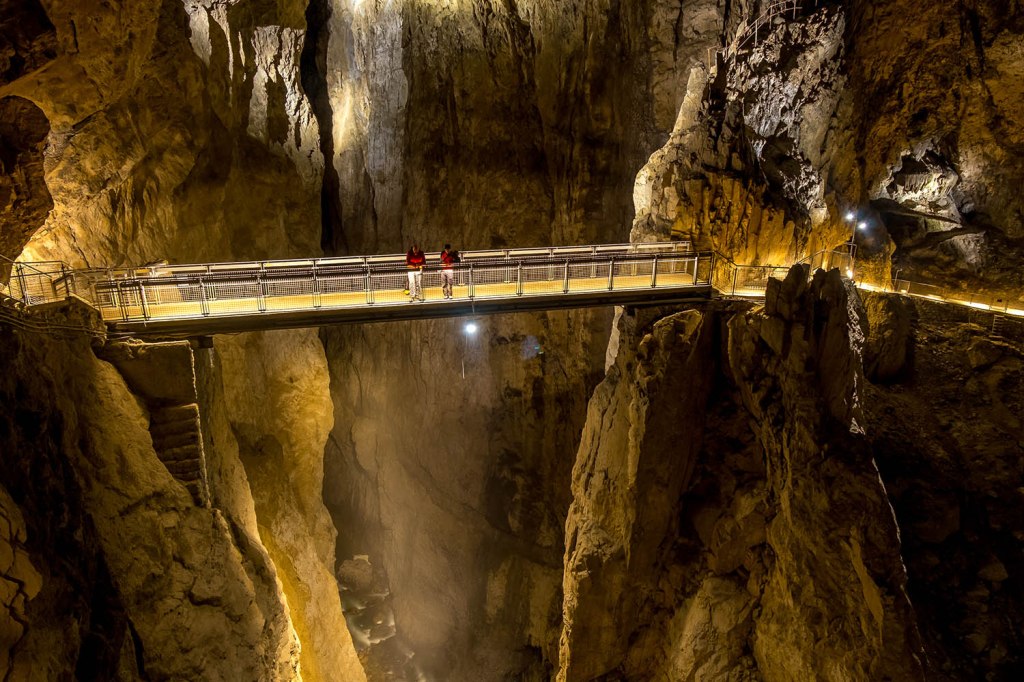
We descended down a switchback path for a very long time to arrive at a narrow ledge running along the canyon walls. It was relatively well lit, and there were railings, but the path was very narrow. I crab-walked along the wall as carefully as I could, while trying to peer down to the river 45m below from the safety of the wall.
This relatively long section of pathway took us to the man-made bridge crossing the canyon, high above the river. I had to do some deep breathing to keep myself calm enough to make it across. The noise, the height, the lighting, and the overall ambience was overwhelming. Rick called out to check on me, but I was too focused to even reply.
A similar path ran along the canyon wall on the far side, next to the raging river below (really, really raging after all the recent rain). We descended for some time, then walked alongside the river (maybe 10-12m above) until we came to a long winding set of stairs that brought us up and out of the canyon. Relief!
The Canyon has been the scene of many significant floods over the years, most notably in 1963 when the water levels rose by more than 130 meters in 2 days – in a chamber that is 2.2 million cubic meters. It is mind blowing to consider how much water that must have been, especially when standing inside that space. Part of the path was closed due to the impact of the heavy rains.
The entire tour was 1.5 hours, though the distance was only 3 km. Rick described the tour as “awesome and terrifying”, a very apt description.
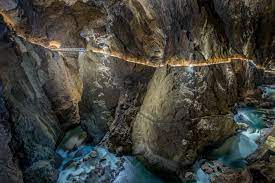
Here are some pictures borrowed from the web. I am not sure if they provide the full scope, but you can hopefully get the idea. The lighted section is the pathway and you can see the river below, which is also turquoise because of the limestone, like the Plitvice lakes.
This is the bridge.
Some stalagmites and stalactites form the relatively tame Silent Chambers.

After our tour we needed a few minutes to collect ourselves. Between the stairs and the humidity in the caves, we also needed to dry out a bit. A coffee helped.
Our next stop was much more relaxed. The Lipica Stud Farm is one of only three locations in Europe where Lipizzan horses are bred and trained. This one has been active since 1580. It was a lovely spot. The weather had warmed up a bit, and a few scraps of blue sky were visible.
The farm is 300 hectares, with multiple training rings and stables. When we entered the property the first thing we saw were the stables where the mares and foals are kept, a delightful intro. Lipizzan horses are born black or dark grey, then gradually change to white over the course of six or seven years. The photo below is a mom and baby, only about four months old.

There are 300 horses at the farm at any given time: stallions, mares, foals, and every age between, all at different levels of training. They start them early, within the first year, though training sessions are only 15 minutes a day, as foals have almost no focus.
Formal training begins in their 4th year and they begin to appear in shows in their 6th year. All of the horses ‘work’, though training relies on the natural their capabilities which makes it fun for them. Training is also varied to keep them from getting bored.
One trainer is responsible for five or six horses. They train every day, except Monday, when they can often be found laying down and sleeping in their stalls, snoring loudly. Horses usually sleep standing up, so when they lie down it is an indication of how safe they feel with so many other horses in proximity.
The horses are carefully bred across five stallion families and twelve mare families. They are named according to their parentage which makes it easy to keep track.
There was a carriage event happening that week so we saw a number of carriages and riders practicing before the show. It was impressive to see the pairs function as a single unit.
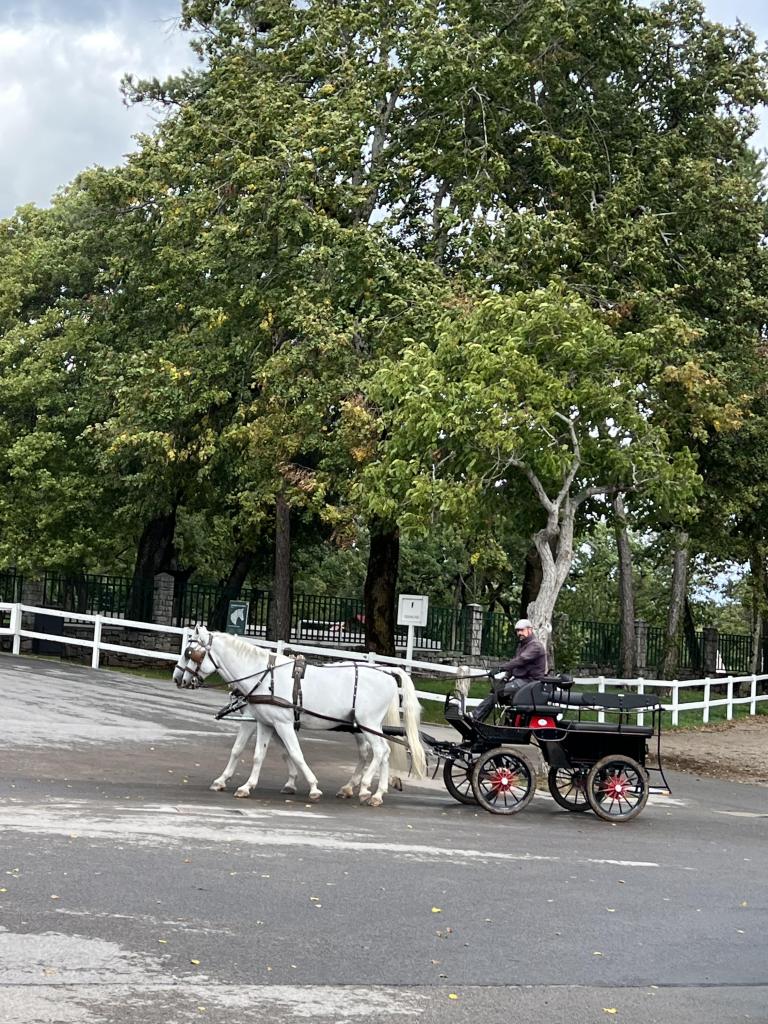
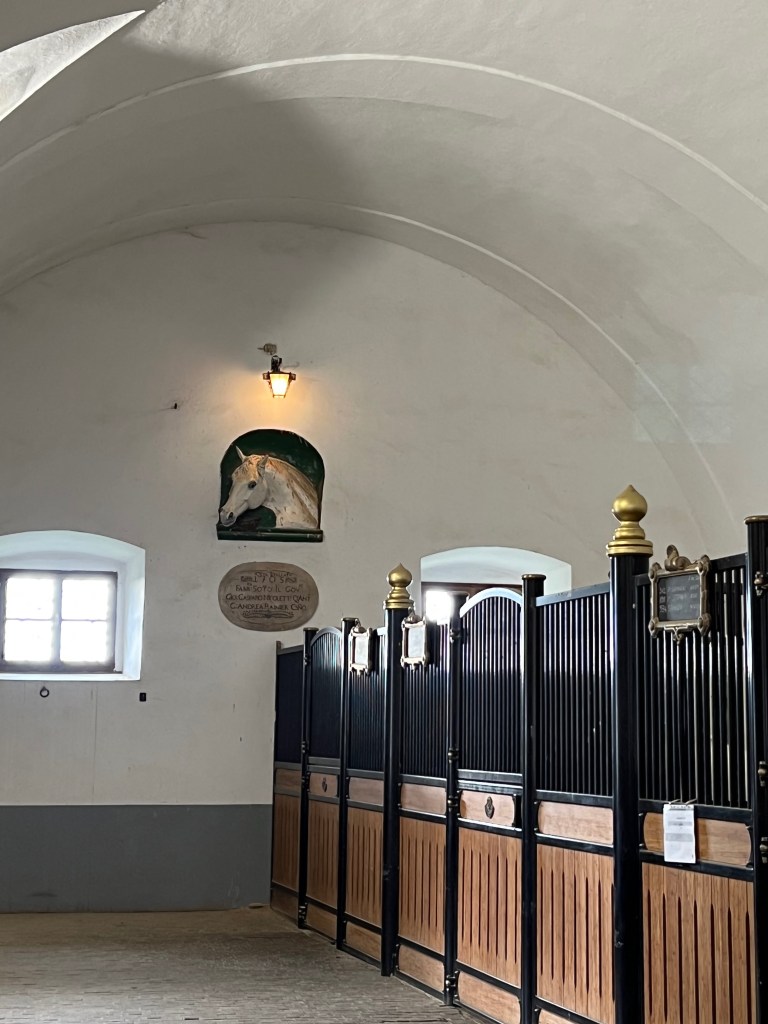
The tour was interesting and we saw a number of horses up close. The stables themselves were beautiful.

Our tour took us close to a small road running out the back of the farm into… Italy! It is only about one km long and is rarely used, except for large trucks bringing in horses to show.
It was a nerve racking journey back to Ljubljana. Although the drive out and back was not long, we had some horrendous weather through the mountain pass. The rain was torrential and at one point all of the cars and trucks on the highway just stopped and waited. Rick drove brilliantly.
After our day of caves and horses, we opted to return to ‘Most’ for another amazing meal. Upon arrival we asked for David and were immediately ushered to a table. Who doesn’t like jumping to the head of the line?
After a brief consultation with David, we had a plan for our meal. We started with a Slovenian cheese & meat board, followed by lamb for me, and a steak salad for Rick (amazing!). After dinner we shared a local dessert made from white chocolate and pumpkin seeds. It was so smooth and creamy and flavourful, without being too sweet or too rich. I have tried to find the name but without success. It was all accompanied by a delicious bottle of Cabernet which tasted a bit more like a Pinot, and was fantastic.
Wine-making is big in Slovenia and they are actually known for their very affordable fine wines. The restaurant has only Slovenian wines on the menu, though they carry a few other European wines for their regular guests who may be tired of only Slovenian wine.
Pleasantly satisfied, we strolled back to our room where we watched a very bad movie on Netflix, and drifted off to sleep to the sound of rain and church bells.


 Adventures of a curious mind
Leave a comment