I am home now, comfortably cozy and still in my PJs at this early hour.
If you know me at all, you know that I am a completionist. I have so many photos of the three chateaux we managed to see in our two days in the Loire Valley, that I am compelled to share them here. So, with a large coffee at hand, Hazel snuggled at my side, and WiFi that really works, let me begin to share the end.
We left our lovely turret room with great sadness after one of the finest breakfasts we had experienced on the trip. I have stayed in so many hotels and BnBs over the years and this one has most definitely been one of the very best. There has been some hefty competition over the years: a castle in Ireland, a BnB in Sonoma, an over-water bungalow in Bora Bora, and a crazy villa in Tuscany (because it was filled with the family I love).
We had chosen 4 chateaux out of the 300 in the 175 mile stretch of the Loire Valley. It was a difficult process involving books, web searches and finally, ChatGPT when we were unable to think any more.
Although the early chateaux were fighting castles, they gradually gave way to stunning palaces of pleasure and beauty in the 1400’s. Tours, not Paris, was the capital at that time. Louis XI was the first to take up permanent residence at the valley at his Touraine chateau.
As royalty goes, so does the court. They too began to buy deserted and ruined castles and convert them to lovely homes and vacation properties. The most intense period of chateau construction was in the 16th century.
We had mapped a route that would gradually take us east. This would allow us to head north at the end of the day, towards Paris and the airport for our return flight home.
Chateau de Chenonceau was our first stop and hands down, my favourite. It is the second most visited castle in France; surpassed only by the Palace of Versailles. It is stunningly beautiful in its position over the Cher River.

I imagine this exact photo exists in the cloud storage of millions of people who have visited over the years. I understand why.
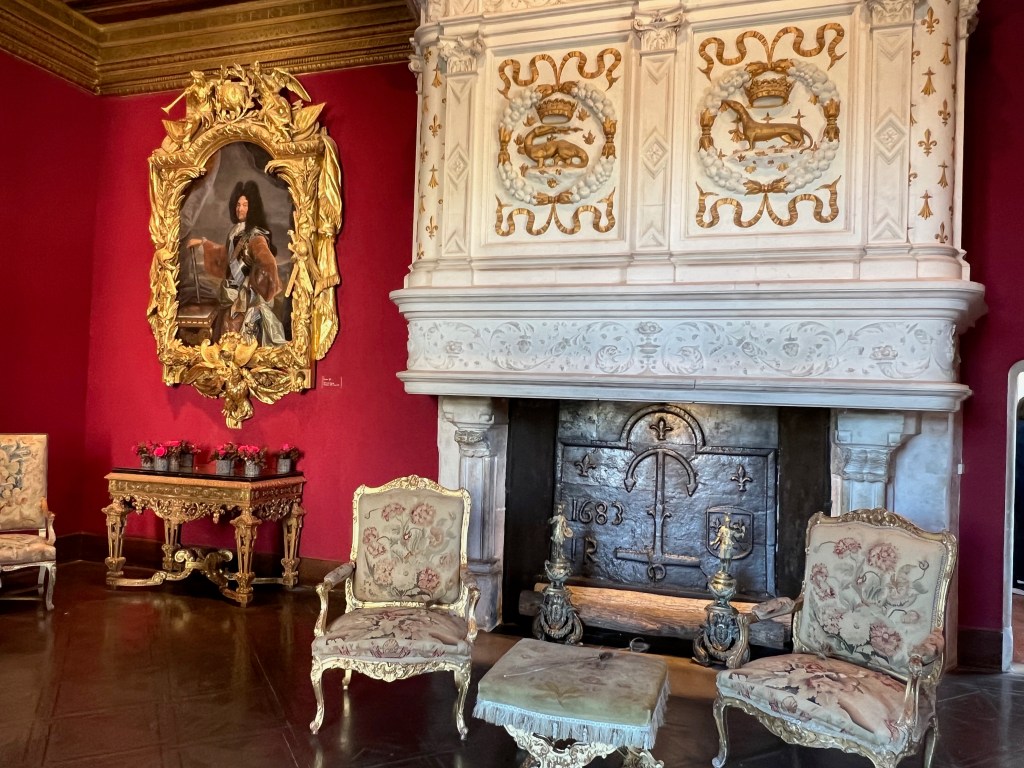


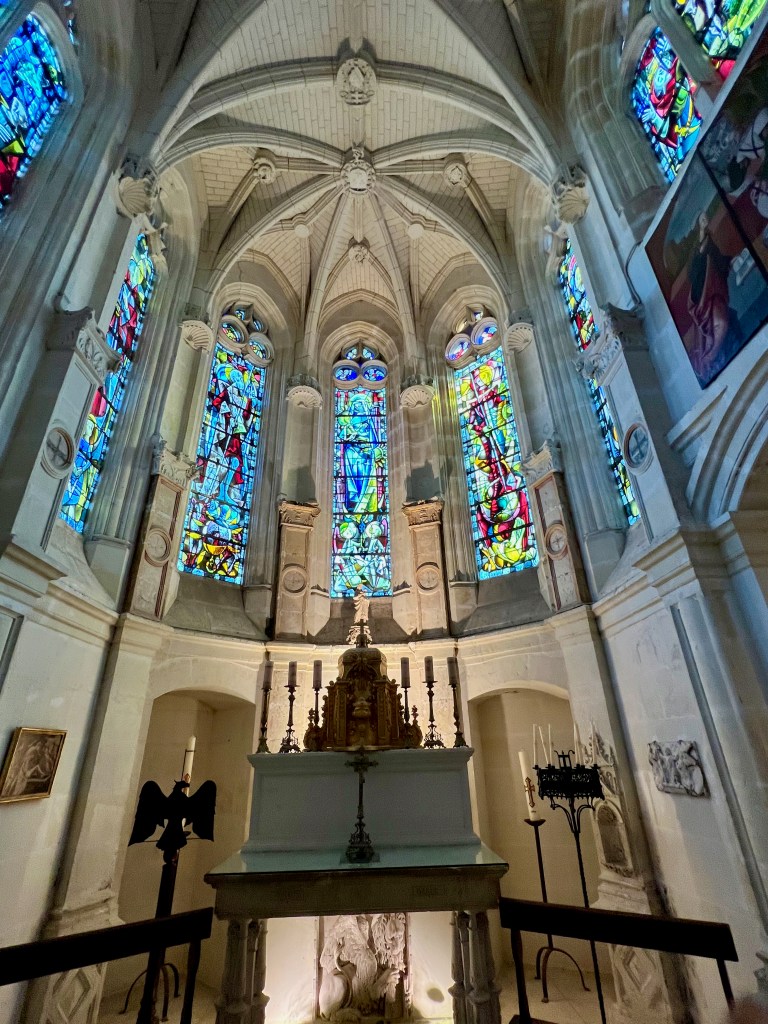
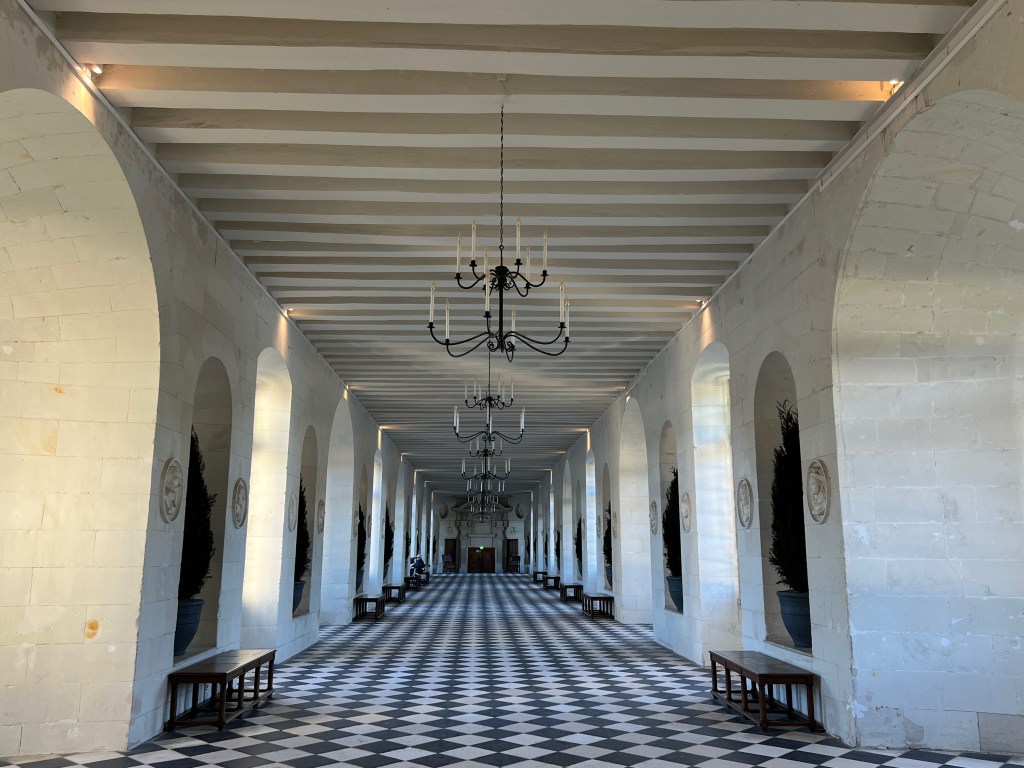
Chenonceau was one of the first chateau, originally constructed in a very simple style in the 11th century. It rebuilt in the 15th, after being burnt to the ground by order of the King. The rebuilt castle was sold to a nobleman, Thomas Bohier, in the early 16th century. He razed the castle again, then spent 7 years rebuilding it in the form we see today, complete with all the Renaissance style moats, dojos, gardens and residence quarters.
One of the large galleries included a large display, telling the history of the Chenonceau and many of its famous residents, which included a surprising number of women. I share one of my favourites here, the story of the infamous was Diane de Poitiers, mistress of Henry II. She was 20 years older than the king; they had first met when he was 7. She was famed for her beauty and followed a strict regime that included potions and ointments as well as daily cold baths in the Cher river.
Passionate about the chateau, Diane de Poitiers was responsible for the addition of the bridge across the Cher as well as expanding the formal gardens and adding the Apothecary and a maze.
After the King’s death, due to a jousting injury (a wooden splinter in his eye), his wife, Catherine de Medici requested that the castle be returned to the Crown. Diane de Poitiers was an excellent business woman and traded it for Domaine du Chaumont which did not possess the same beauty, but came with significantly more land.
In my next life I would like to return as the florist responsible for creating the dozens and dozens of floral displays throughout the castle. Or perhaps one of the gardeners responsible for the formal gardens as well as the vegetable and flower gardens. Either would be delightful.
After 2+ hours at Chenonceau, our next stop was Château Clos Lucé, where Leonardo da Vinci lived out his final days (1516-1519). He worked on several projects for the King of France, and was surrounded by his students.
Clos Lucé is actually quite a small chateau and, unlike Chenonceau, is almost empty except for a few rooms and displays of Leonardo’s many inventions. On reflection he was most definitely a genius, though it is also possible he actually was an alien.

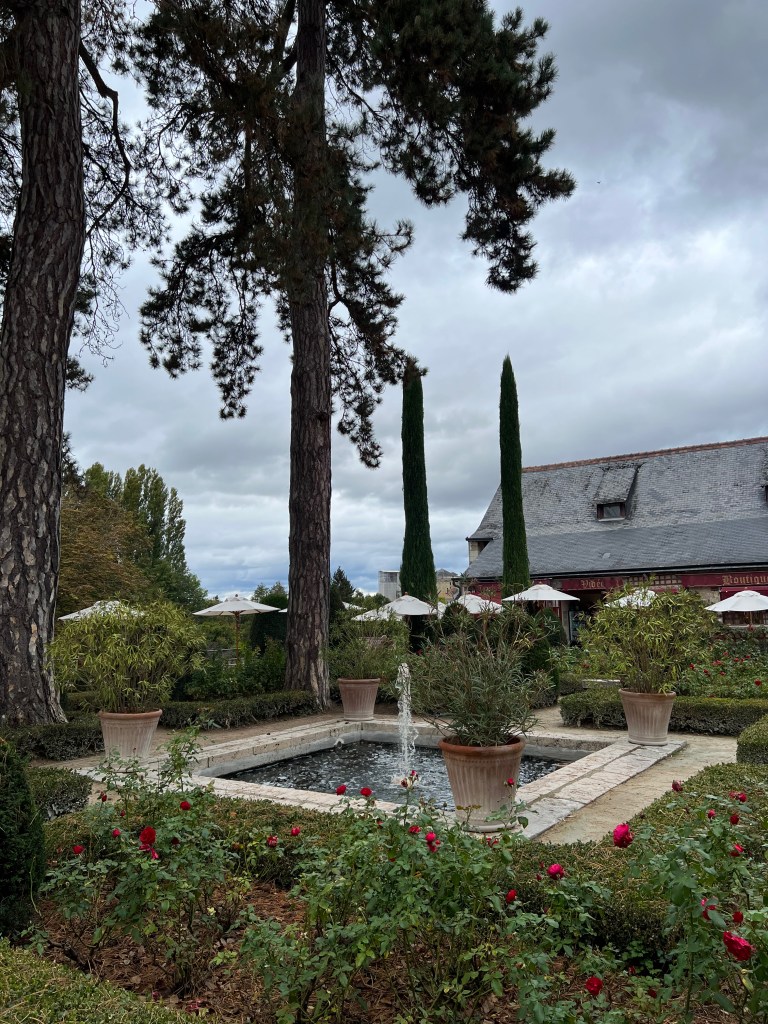
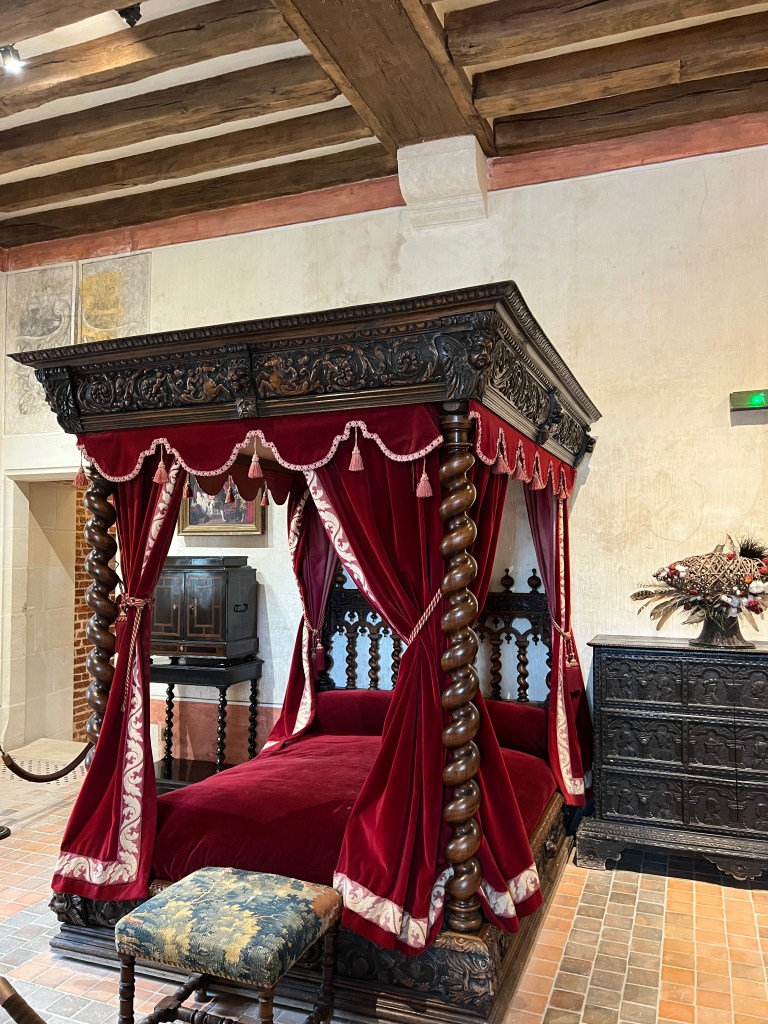
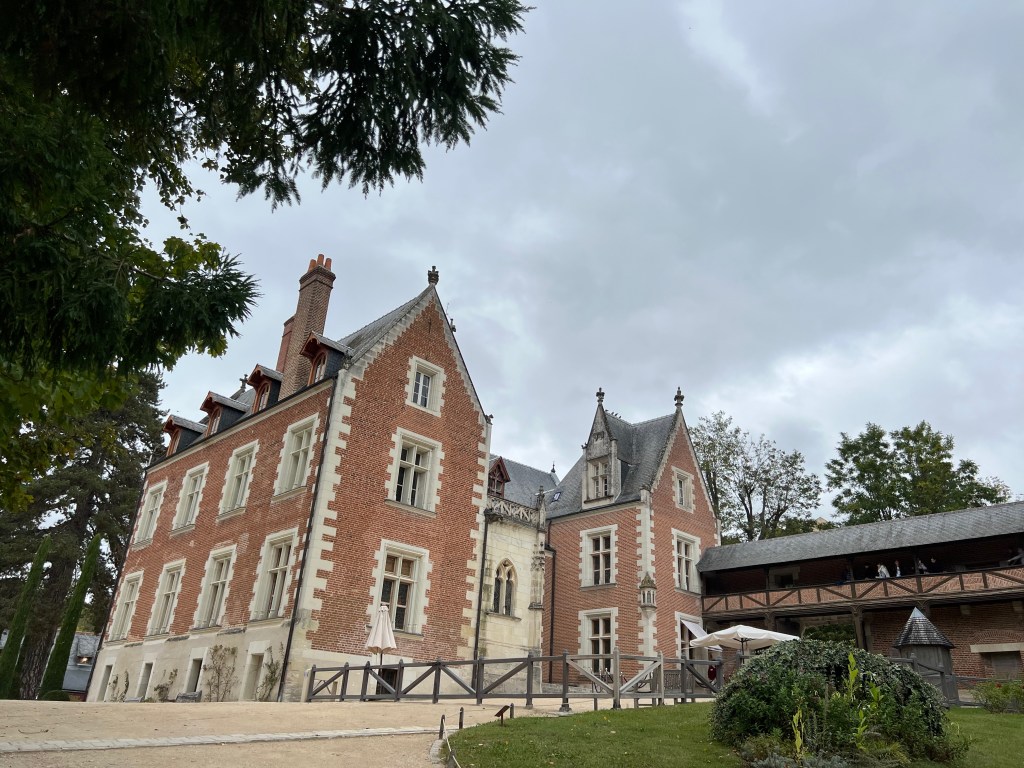
With time marching on, and rain just beginning, we agreed to abandon our proposed 3rd chateau and go straight to the 4th, Chambord. It is the the largest of all the chateaux in the Loire valley and by largest I mean immense!
Even in the pouring rain, it was hard not to stop and admire it’s size. I cannot say it was beautiful; it was just too large for that adjective to apply. It was perhaps a bit overwhelming in its sheer grandeur.

Chambord was built as a hunting lodge for Francis I, who maintained multiple royal residences nearby. The original design of the chateau is attributed to a Tuscan architect Domenico de Cortona, though Leonardo Da Vinci is reported to have had some influence on the design. Construction began in 1519 and took 28 years to complete.
The most intriguing feature is the double helix staircase in the centre of the chateau. We tested it, as did many of the other visitors. Rick stood in place on one of the staircases, while I came up the other side. We could see each other by peeking through the openings, but never passed.
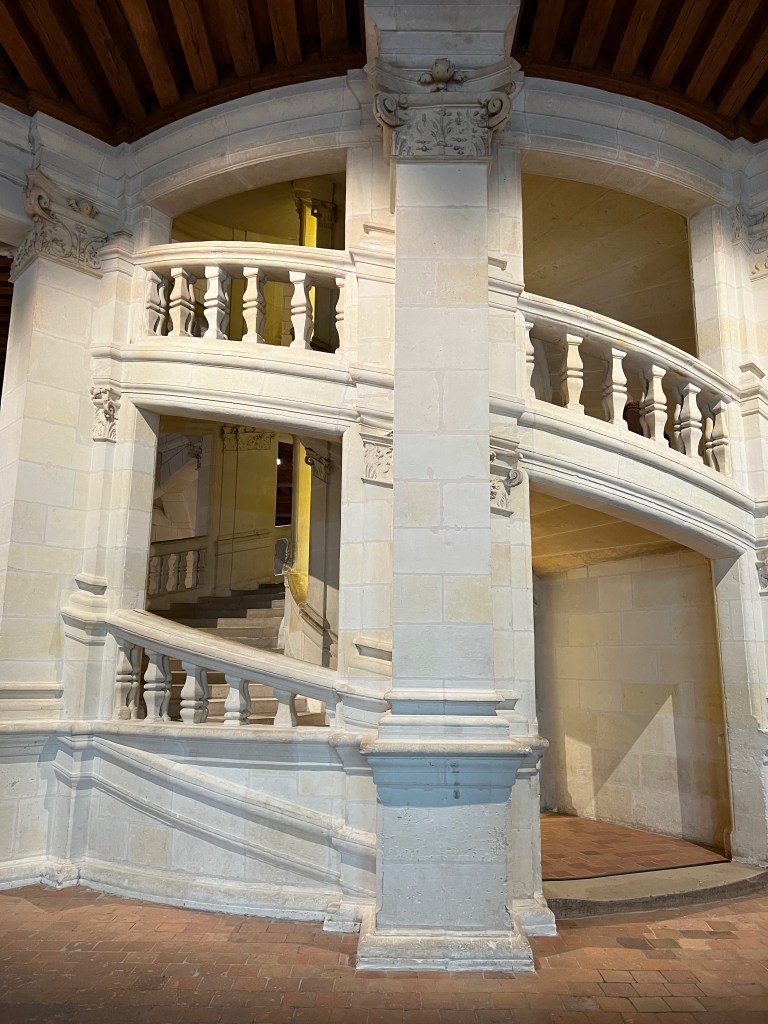
The interior was not generally well-furnished. There were some interesting historical displays and some amazing art. Although the chateaux were not generally heavily furnished, much of the furniture was moved with the occupants when they came to stay.


The roof was one of the most impressive spots. It reminded me of the Gaudi’s Casa Mila in Barcelona, with interesting chimneys and roof towers in 14 different varieties.
There were dragons like the one in the 5th photo all over the chateau. It shows up on mantles, fireplaces, ceilings, furniture, downspouts… and rooftops.


I was soaked almost through in the walk from the parking area. Although I dried off during our visit inside, by the time we had explored the rooftop and crossed the courtyard to visit the Chapel, I was soaked again and ready to go. It would be a long drive to our hotel near the airport.
The closer we got to Paris, the worse the traffic became. We spent as much time travelling the 40kms around the city as we had spent travelling the 160kms from Chambord to the outskirts of Paris. If I had ever seriously contemplated living in Paris, that drive would have been a significant deterrent. Though on reflection, actually living in Paris would probably not require a car. Maybe a moped?
The rest, well, it was all just about getting home. The Melia hotel near the airport was adequate at best, with terrible food in the restaurant and a sink in our room that did not work. Rick was pretty fascinated by the huge, round, orange mirror that separated the sink and vanity from the bedroom.
I have always experienced Charles De Gaulle airport as a confusing mess and we certainly experienced it when trying to find the hotel, then again with the rental return. Even the GPS was not particularly helpful. Ultimately, Rick spotted a sign in a moment of sheer good luck and that is what got us there.
After 2 long flights, we are home. Sleep was poor, but coffee freely available so I did not mind too much. Laundry is underway and the Austin F1 race is on TV. It is almost time for another dog walk. Normal life returns.

 Adventures of a curious mind
Leave a comment