We spent the night at Egilsstadir and woke to morning rain. The forecast was mixed, so we packed the rain jackets back in our pack and were off to see the East Fjords before 9:00 a.m.
The Eastern Region of Iceland is known for its extensive fjords, which are longer, with very different scenery than those in the northwest. (Someone asked about the difference between a fjord and a bay; this first is V-shaped and the second is U-shaped. I like the simplicity of that.)
The landscape is a mix of rugged mountains and beaches with small fishing villages and a sparse population. The villages are mostly small, actually let’ go with tiny, as many have as little as one hundred people. The residents work primarily on farms and fishing, though there is an aluminum smelter that employs 400 people and some fish farming for a Norwegian company. Tourism is less active here, but growing.
The largest village is the one where spent last night. It is the major centre in the area at just over 2000 people. It has a small airport but visual landings are required.
The start of our journey had us ascending a pass up and over a mountain. Snow was falling as we approached the higher elevations. Berclind pointed out small orange buildings off to the side of the road. They were built as emergency shelters, before cell phones we widely in use. Inside the huts are emergency rations of food, a stove for heat, and a radio to contact emergency help. If caught up in terrible weather, then the huts are there to help people survive. Unfortunately, tourists began treating them as free hotels. I am actually not sure if they are still in use, though I did try to find out. My guess is no.
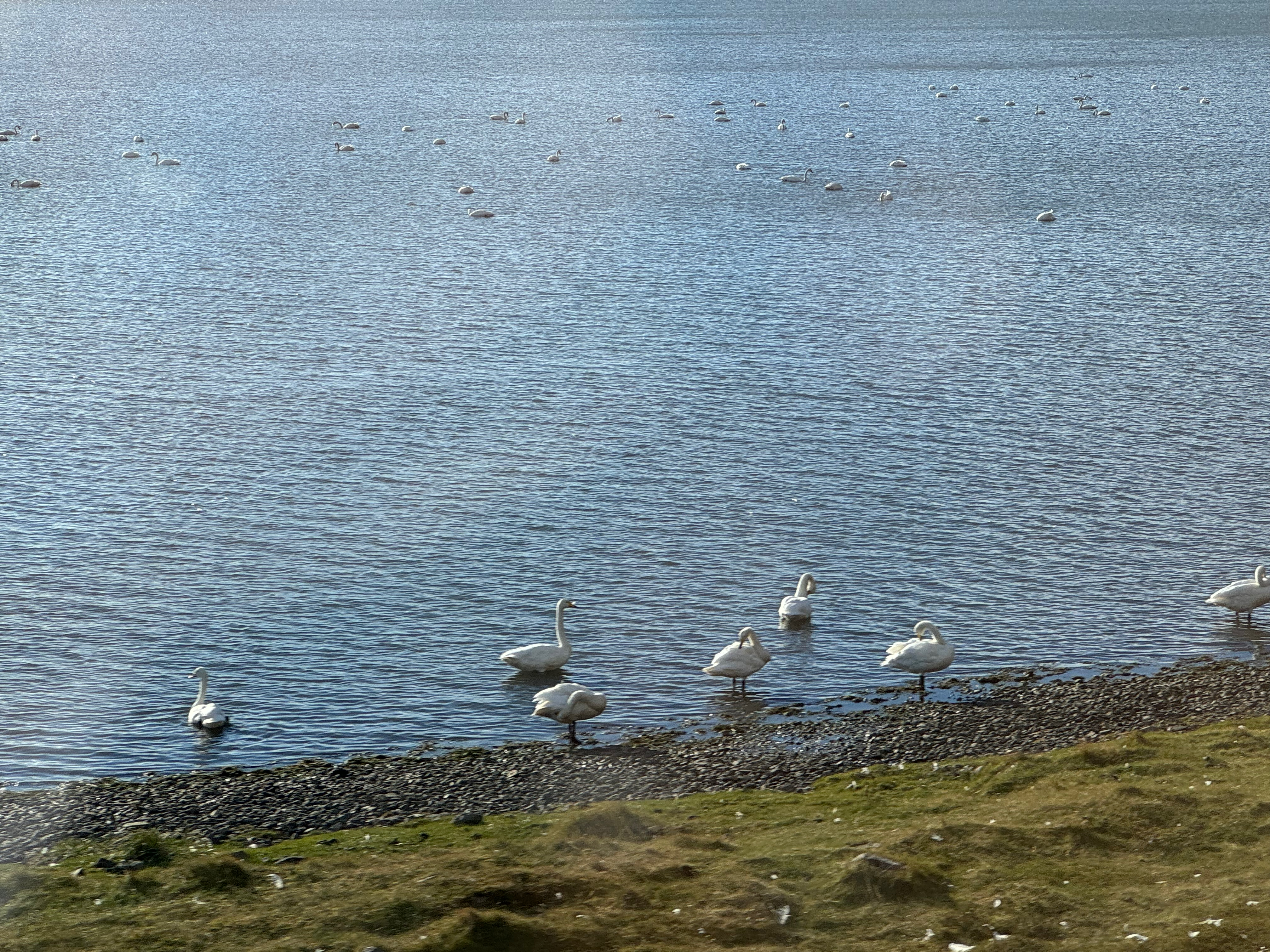
On the other side the scenery was varied and beautiful with long stretches of blue water, jagged mountain peaks, and the ever present waterfalls.

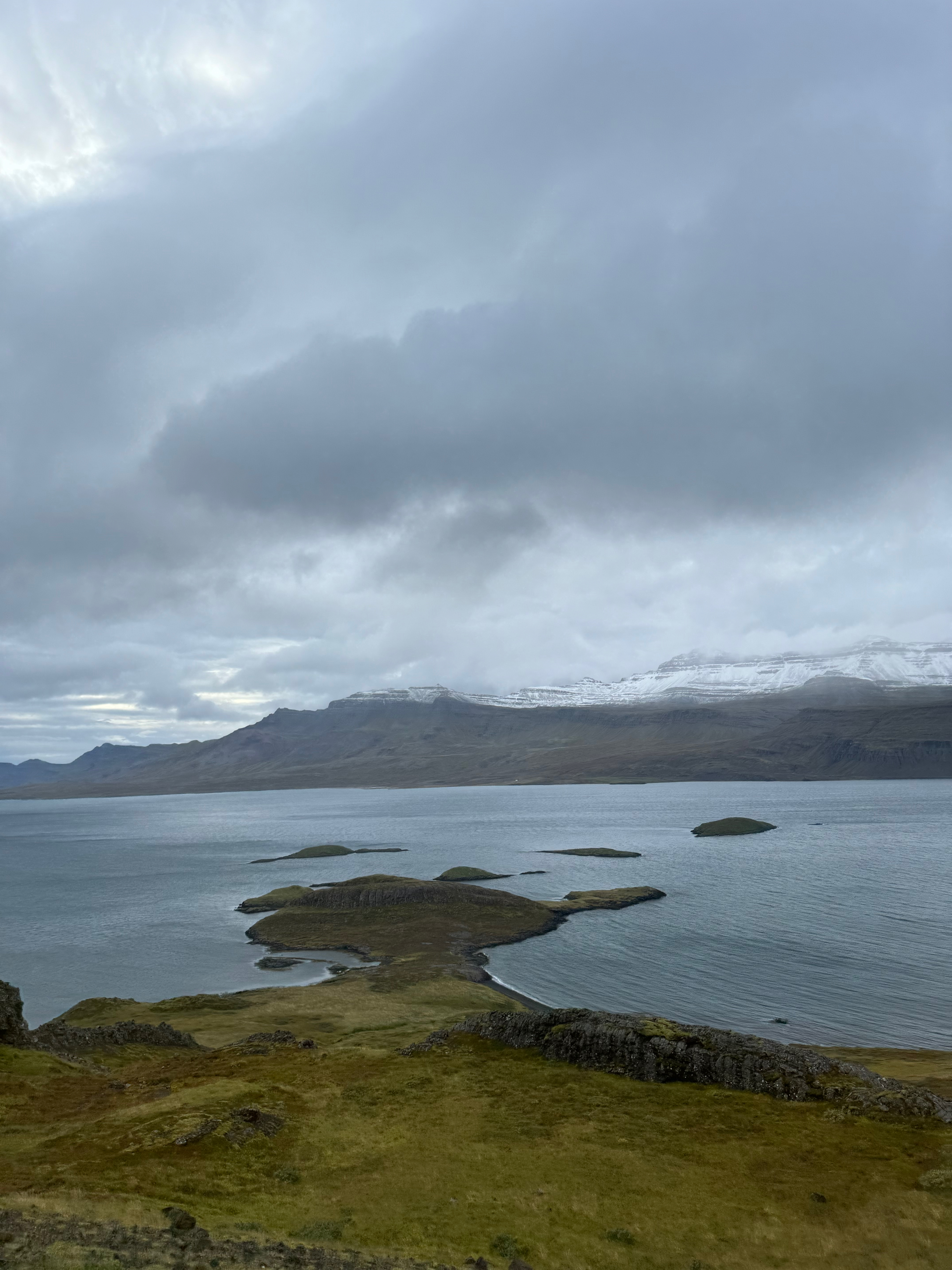
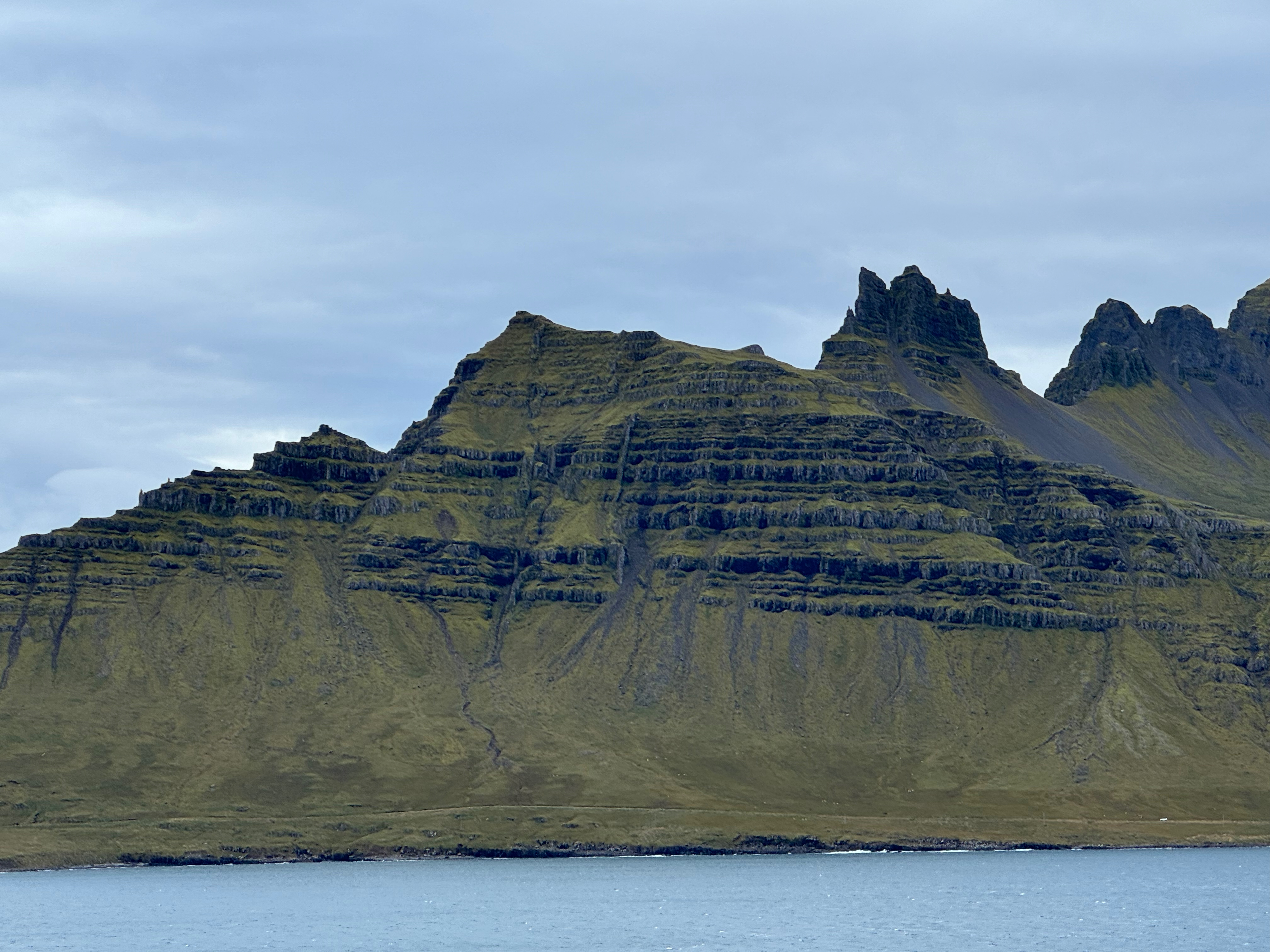

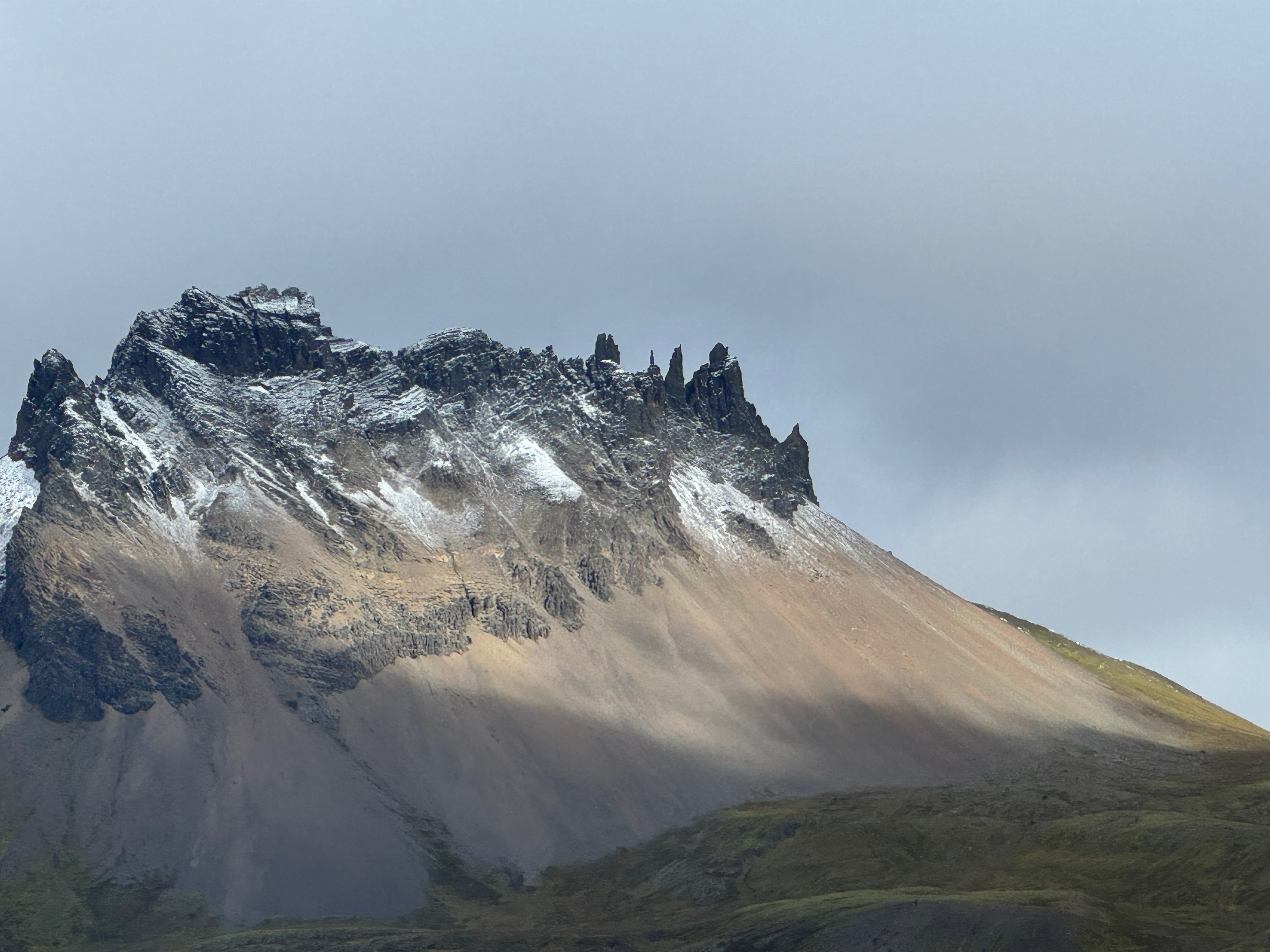
There were also many more trees (in relative terms). Before the Vikings came, Iceland was a densely forested; trees covered as much as 40% of its area. Today, with reforestation efforts, only 2% of Iceland is covered with forest. More trees are being planted around the country to help combat erosion. Many of the trees are imports from other countries, including Canada. About 2 million trees are grown in large greenhouses every year. Anyone cutting a tree must replace it by planting two.
Of course there are still plenty of grazing areas for the thousands of contented sheep. In this area we see many more of them up on the rocky hills where they seem quite sure-footed.
We drove past a field of sheep with one lying on it’s back, all four feet up in the air. I have seen most sheep standing, some lying down on their stomachs or their sides but never this. I looked it up and it was not great news. Sheep cannot right themselves when they are on their backs and need to be rescued. Waterlogged fleece can be the cuplrit as it can be 1/4 of a sheep’s total body weight. I am going to assume that if I saw it that easily from the road, someone who knew what to do would have as well and either flipped it themselves or contacted someone who could. Poor little sheep.
Most of our journey consisted of brief stops to see a wide range of natural scenery. I am not able to describe them in the exact order, but I will assume that doesn’t really matter much, so here are a few highlights.
Our first stop was a viewpoint overlooking two fjords. I was most intrigued by the story of a psychic who asked that her body be buried under a rock cairn between two fjords so she could protect them. The magic must have worked. In the 1600’s a group of Algerian pirates were mysteriously blown out of the fjord before they could do any damage. A similar story exists regarding a German plane in WWII, thought my recollection of the details is a bit sketchy. I did try to locate the cairn, though sadly Berclind believes it is located up in the hills and therefore unreachable.
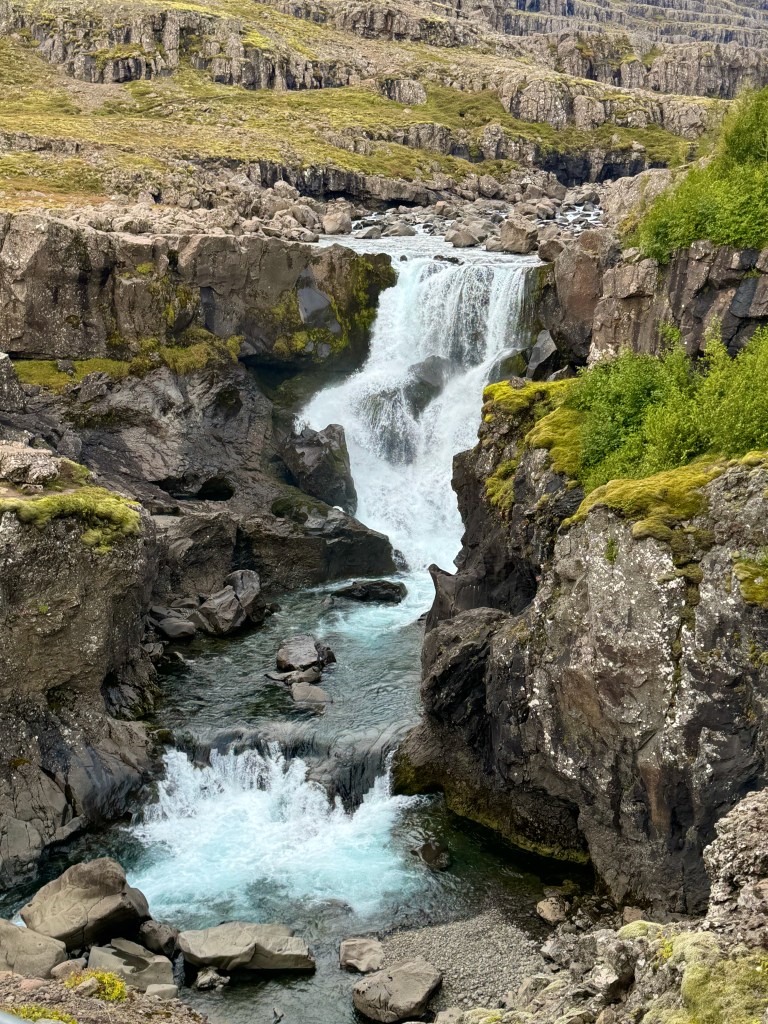
One of our short detours took us up a very steep and narrow road to a parking lot near Fossarfoss, a 15m waterfall framed with black basalt. It was worth the rather precarious drive. The wind was really blowing while we were there, so even the short walk to the falls was challenging.
We had a brief stop at the Blabjorg cliffs. They are made of iignimbrite and were formed by a spike in explosive eruptions 9 or 10 million years ago. They stand out from the rest of the scenery because of their blue colour. The rock is very different.
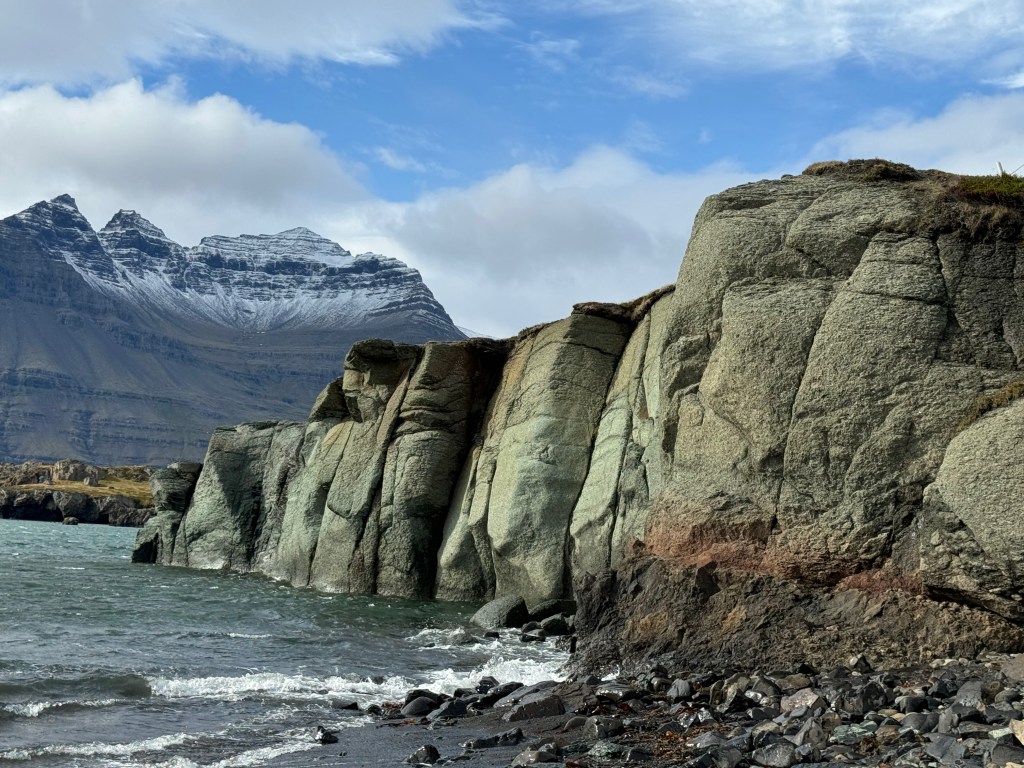

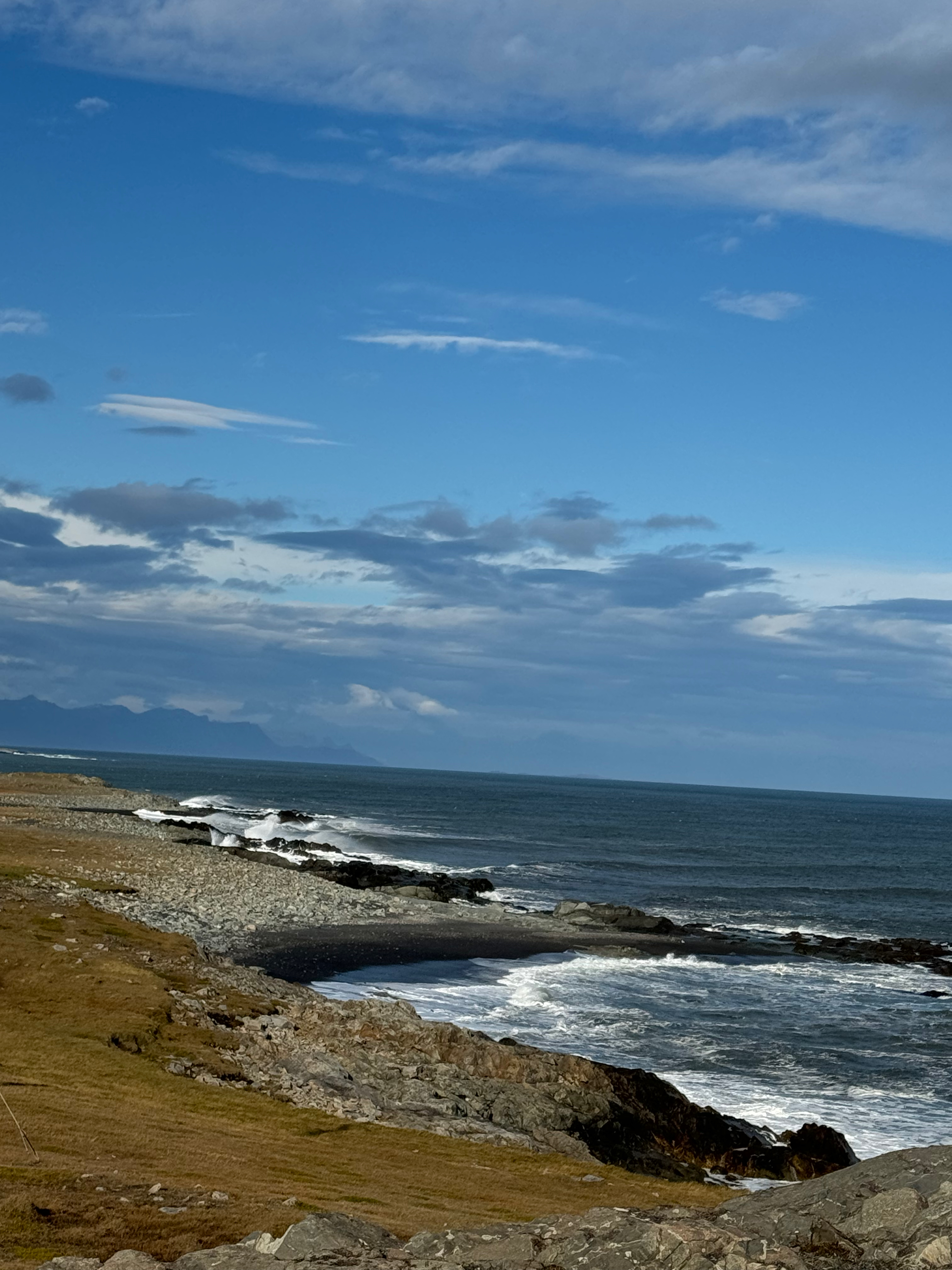
We took a flat but also precarious road a few hours later to the Hvalnes Lighthouse and some beautiful black sand beaches. I think Rick and I were a bit smug about the beaches as they do resemble those out near Ucluelet. We were particularly enamoured with the huge bird cliffs nearby, though the wind chased us back into the bus after a fairly short walk.


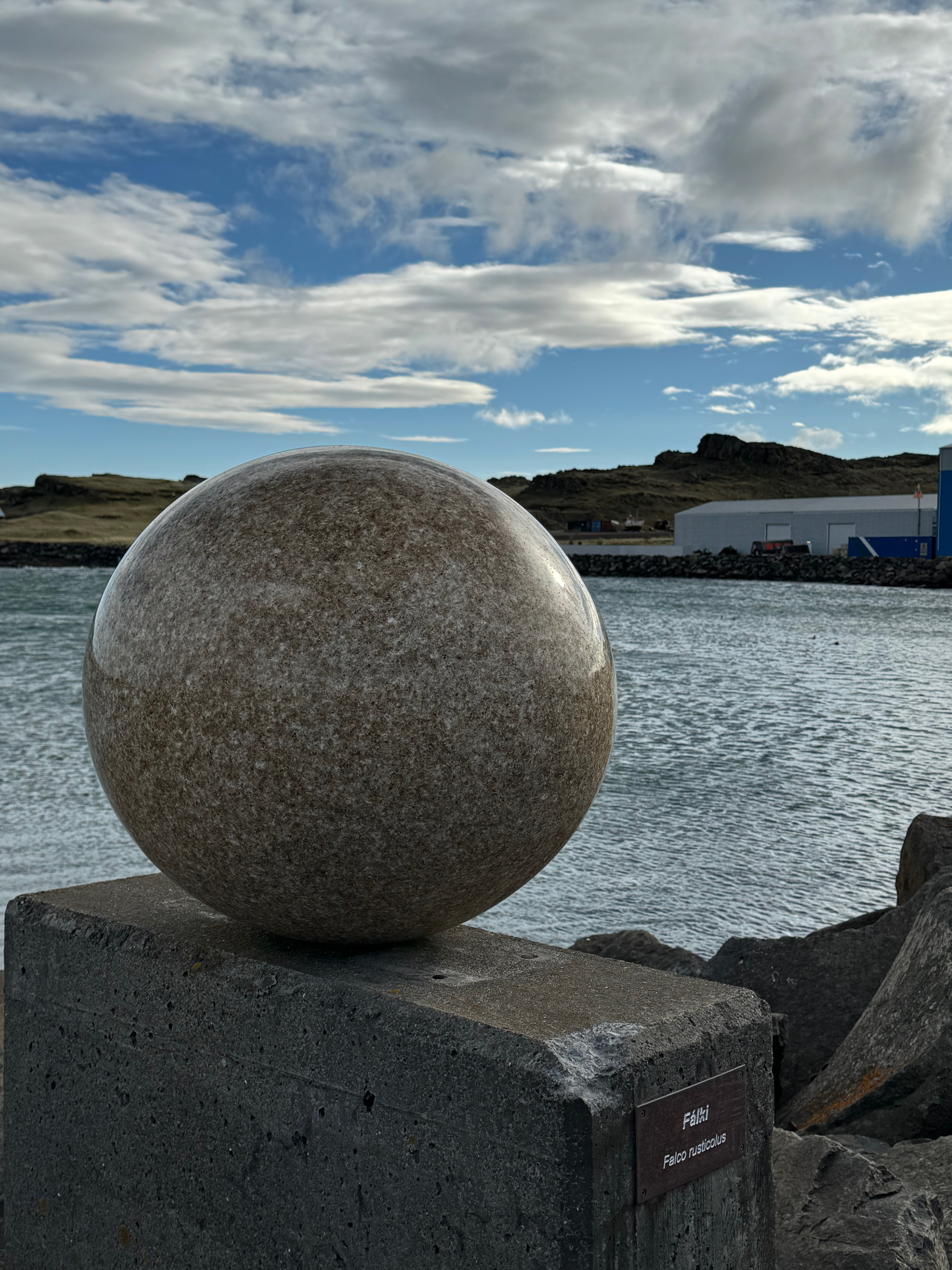
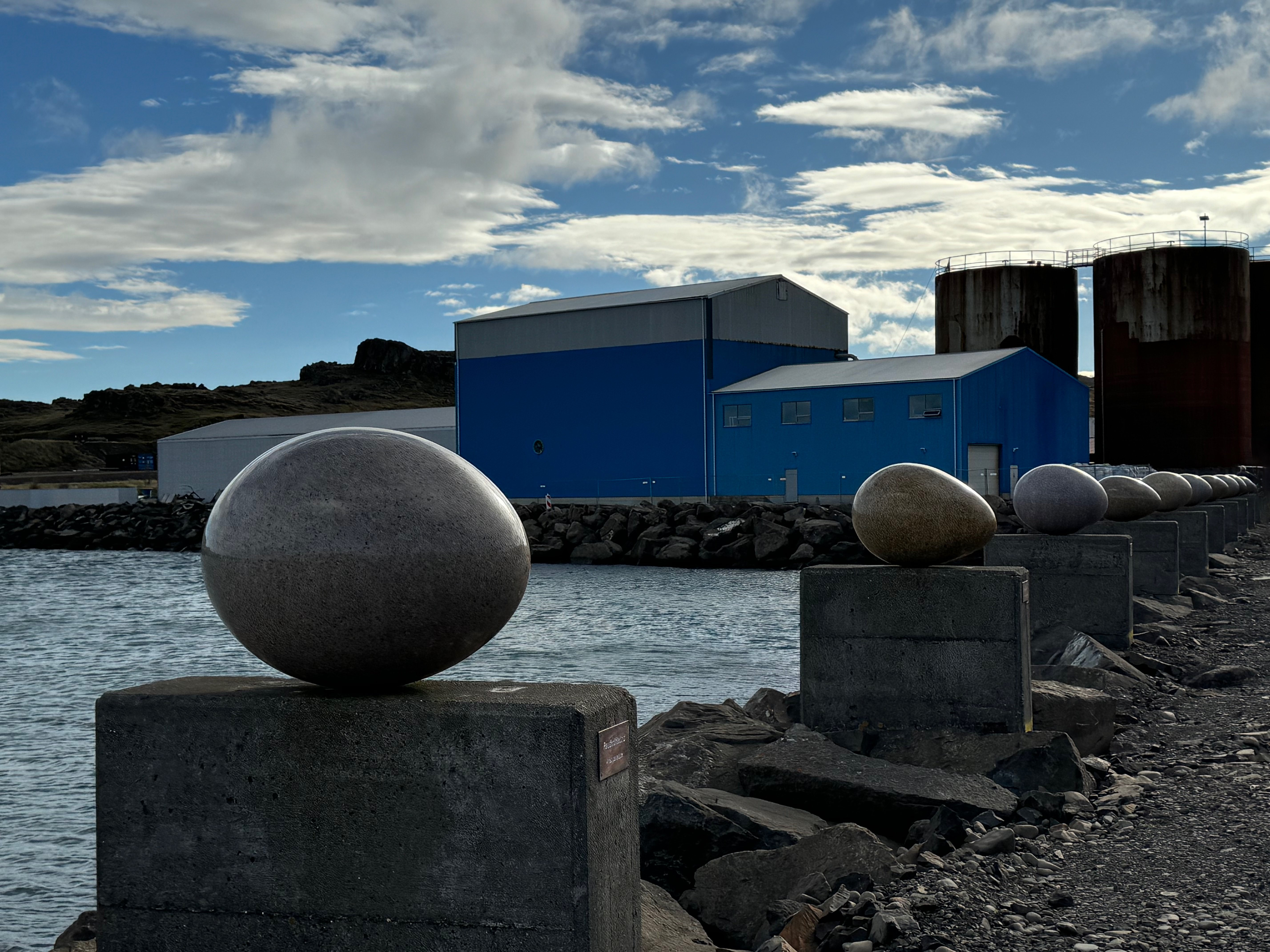
The Eggs of Gledivík were a very cool (make that cold) art installation along the harbour in the village of Djupivogur. It consists of 34 large stone eggs, each representing a local different bird species, and was created by Sigurdur Gudmundsson. I am perching on the Eider Duck egg and the very large one is a falcon egg, the only one that is completely round. It is amazing how different the shapes are.


One thing that has consistently befuddled me on this trip is trying to see something to the left or the right of the bus as Berclind points it out to us. By the time I have figured out what right or left is in the real world we are long past the sight in question and I am left crazily swivelling my head with nothing to see. I have more success when she uses a clock reference. When all else fails, I find the coffeehouse, the restaurant, the gallery, or the museum by simply following the crowd.
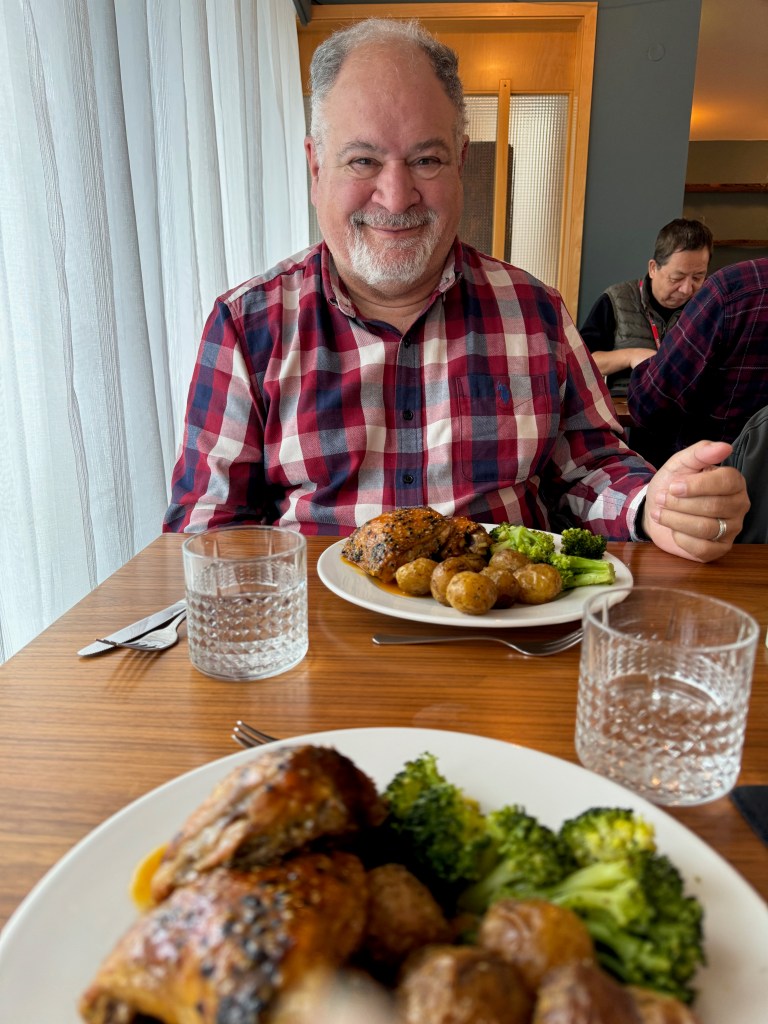
We stopped for lunch in the village of Breidalsvik. It was very simple; chicken, potatoes and broccoli, and likely one of the best meals we have had so far. I gave their trampoline a try – it was loads of fun though the mound shape made it difficult to navigate at times. I imagine this is a much safer version for children (and inexperienced adults with bad backs).

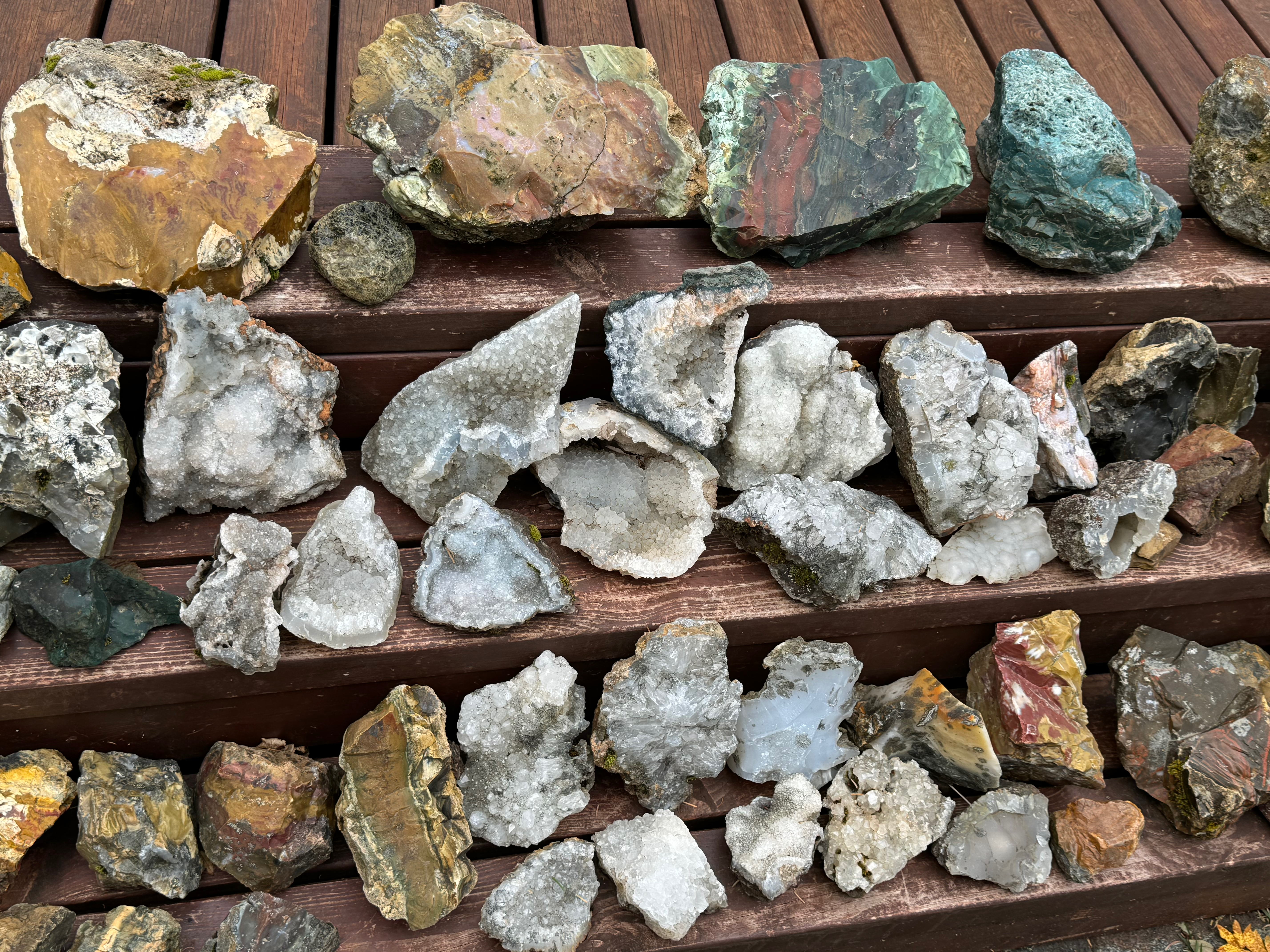
I have saved the best for last. Without a doubt – this was one of my favourite stops: Petra’s Stone Collection. Petra lived in the tiny village of Stodvarfjordur. She had begun collecting stones at an early age; and clearly stones were her biggest passion.
She would climb the mountains near her house alone, with friends or with her children, collecting rocks of interest as she came upon them. It was not unusual fr her to return with 40 kgs of stones in a rucksack she carried on her back. Some of the larger stones had to be hidden until winter came and she could bring them down on a sled. She managed to build her collection over many years, while also busy raising a family and working at the fish house.
Her little cottage simply overflows with rocks and minerals. Only the kitchen and her bedroom remained as usable spaces. The garden is also filled with them and enhanced by flowers and sculptures. Everything is carefully labelled. The cottage is now a museum and run by her family.


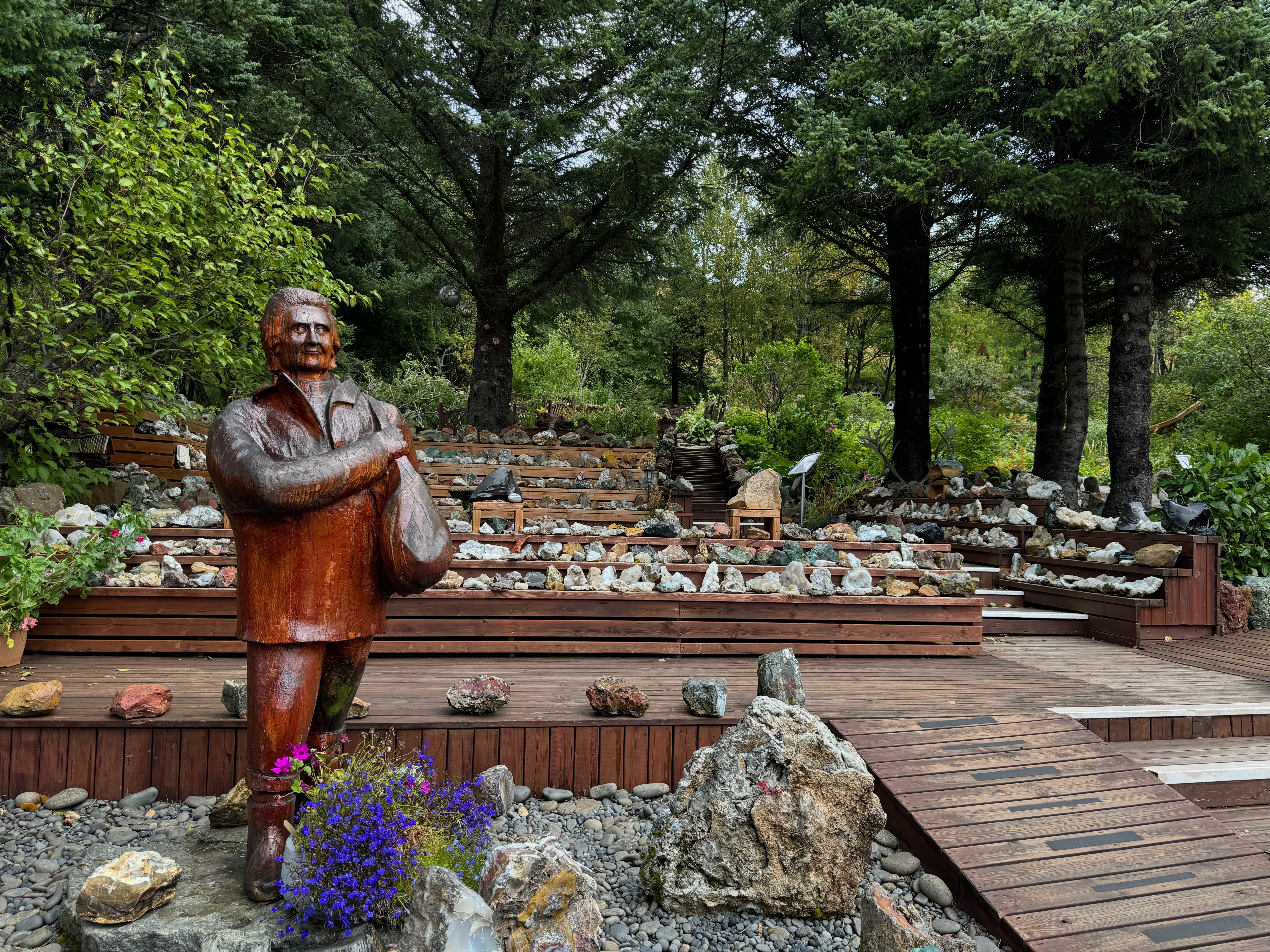


We were so enamoured with the place that Rick bought a book about her (it was published only weeks before Petra died) and I bought a few small stones including a piece of obsidian that I was obsessed with. Perhaps this description of obsidian’s characteristics will make sense: “Obsidian is a highly-regarded protective stone, known for its ability to block, absorb, and transform negative energy. Obsidian is believed to be a stone of clarity, with the ability to release emotional, physical, and spiritual blockages, drawing out stress and tension.” Well, that sounds about right….
I will say I have not been myself since arriving in Iceland. I have not fretted or worried about anything – not even the risk that our return flight could be cancelled at any moment. (The Air Canada pilots have thankfully reached a tentative agreement). I have not thought of work once. I am sleeping well. I don’t make myself crazy trying to get the perfect photo of a waterfall or a rainbow – or anything else for that matter. This is a good me. A happy me. A calm me.
There are some interesting theories about the Snaefellsnes Glacier that I have been pondering. Beyond the belief that UFOs may have landed on the glacier, there are tales of its ability to enhance one’s emotions the closer you get to it, and that it is one of seven great energy wells in the world. I am not sure if any of that is true, but maybe the glacier deserves the credit is for my unusual calm on this Iceland journey?
Or perhaps it is the clean air and the very simple life. Or that someone else has complete control over what happens for the duration for the day; there is nothing left for me to plan. But I am grateful for this change in perspective, not matter how brief it may be.
Today is glaciers and icebergs and a boat ride on the lagoon. We had our first look at the glacier yesterday, though it was hard to capture good photos in the bright sunlight.


The weather forecast is very rainy. We are prepared, and I am sure I won’t mind in the least. It will just be another story in this grand adventure.


 Adventures of a curious mind
Leave a comment