We are back home now, recovering from the inevitable jet lag. I also managed to pick up a pretty nasty cold/flu in the last day or two. However, there are a last few adventures, to share and a few random snippets to note before I close this chapter.
Our final day was spent touring the Golden Circle, a 300 km route that includes 3 of Iceland’s popular natural attractions: Thingvellir National Park, the Geysir geothermal area, and the Gullfoss waterfall.
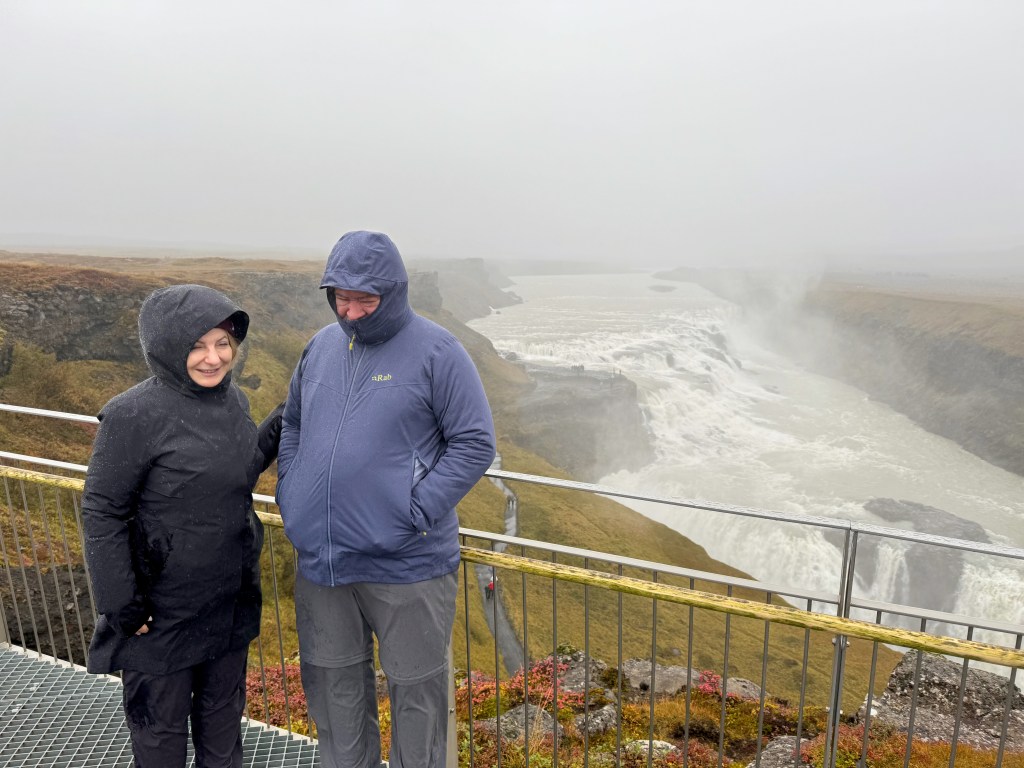
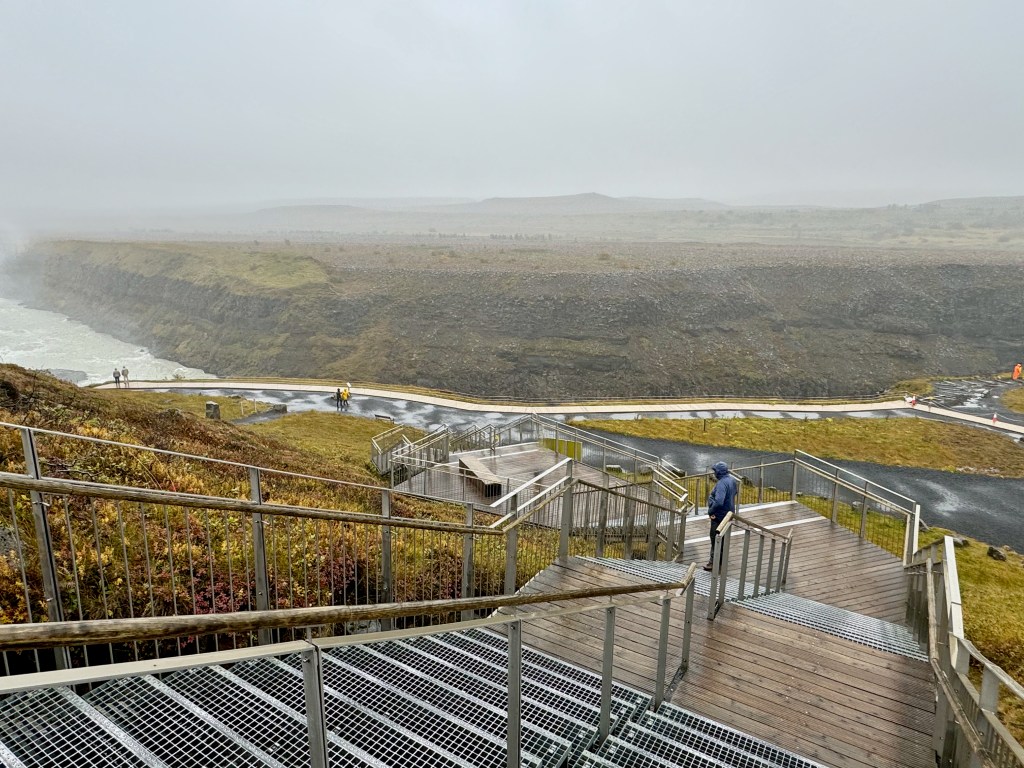
The first stop was a very rainy Gullfoss, “The Golden Waterfall”. One of the most beautiful and powerful waterfalls in Iceland, it consists of two tiers dropping a total of 105 feet. Here we are.
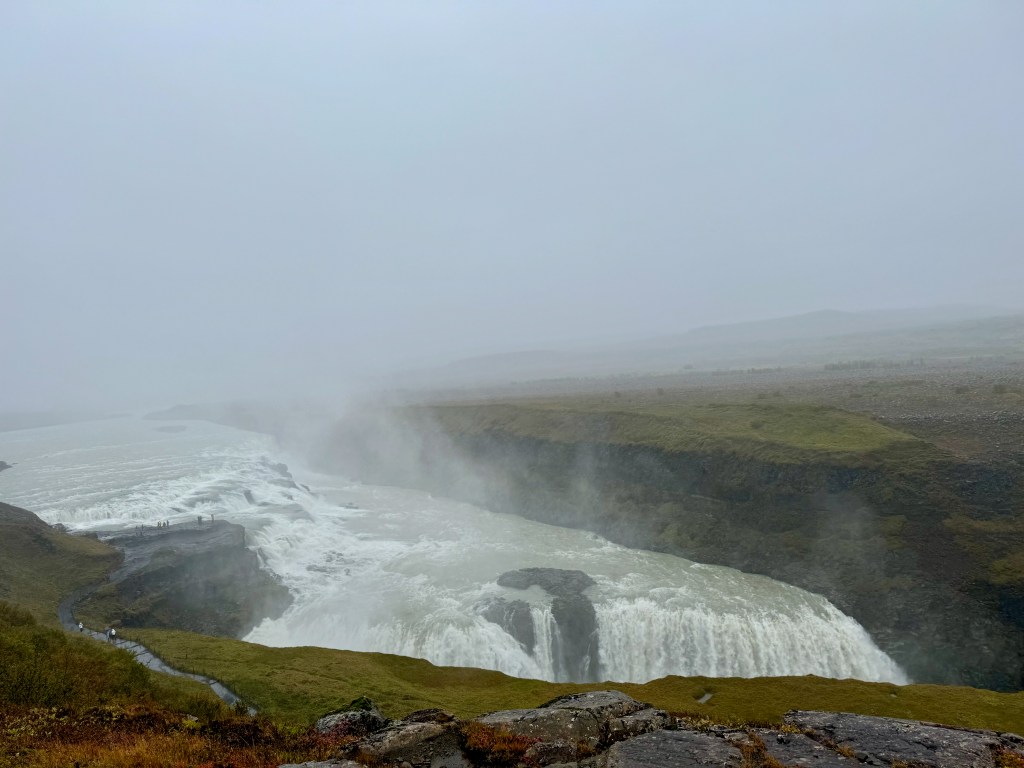
If you have ever heard of Gullfoss, or seen photos, they typically look more like this:

In the early 20th century British developers developed plans to build a hydroelectric plant that would have destroyed the falls. Sigridur Tomasdottir, the daughter of a farmer living near the waterfall, played a key role in protecting the falls. There is a memorial near the falls, honouring her as one of Iceland’s first environmentalists.
Sigrudur was asked to sit for the artist who did the memorial plaque. She found ways to avoid the artist entirely, and would often look quite unhappy even when he could find a moment to sketch her. When he finally had a sketch he liked, he left it for her to look at; she burned it. In the end, he sketched her from memory and that became the image for the plaque.
Our next stop was the Geyser hot springs area, filled with bubbling mud pits and some geysers. Stokkur is the largest, spouting a 30m high column every 5 minutes or so. The actual height can vary with the temperature and weather. A rainy, cool day suggested that we might want to manage our expectations. There was a time when 50 lbs of soap flakes were regularly added to the geyser to increase the size of its spout. They stopped doing it several years ago so what we saw was all natural.
The geo-thermal field is very hot with 80-100 C water. There were loads of warning signs to stay back. The high sulphur content also meant that it smelled quite strongly of rotten egg. Unfortunately, the steam blended in with the fog and clouds quite quickly, so you don’t get the full effect in the photos. It really was quite impressive live.


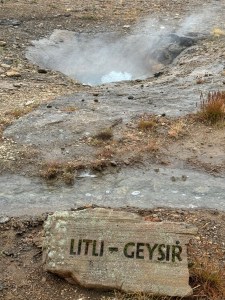
I rather liked this little one that burbled more than spouted.
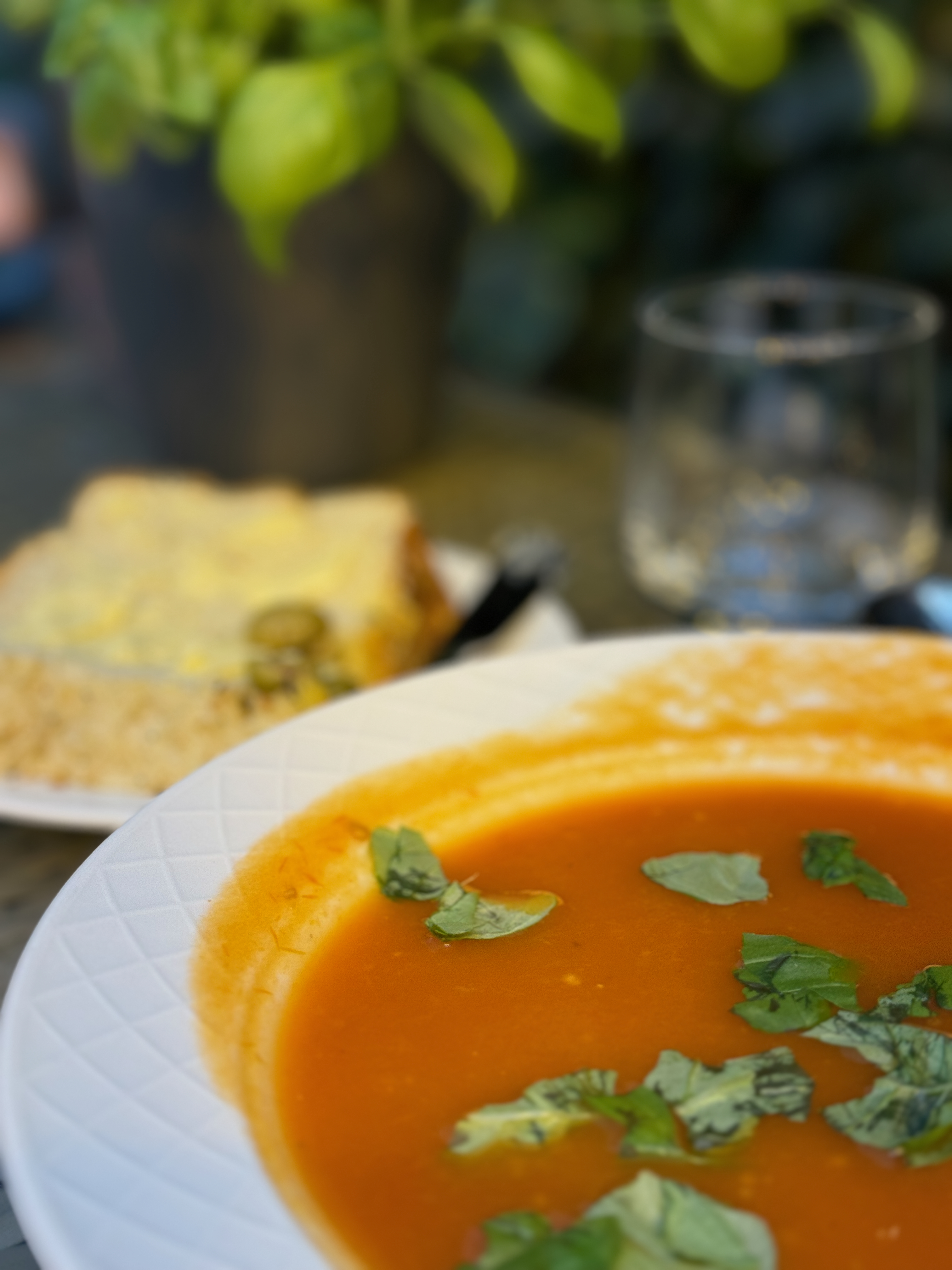
Our lunch stop was at the Fridheimar Farm. They have 27 greenhouses where they grow delicious tomatoes. They produce 200,000 a day, all consumed in Iceland – no exports. This is possible because of easy access to cheap power for the lights and geothermal water for heating. Imported boxes of bees from the Netherlands are used to pollinate the plants. The soil comes from Finland as the Icelandic volcanic soil is a poor medium. We had the most delicious tomato soup and fresh bread for lunch. There was also a Bloody Mary bar – which we regrettably did not try.


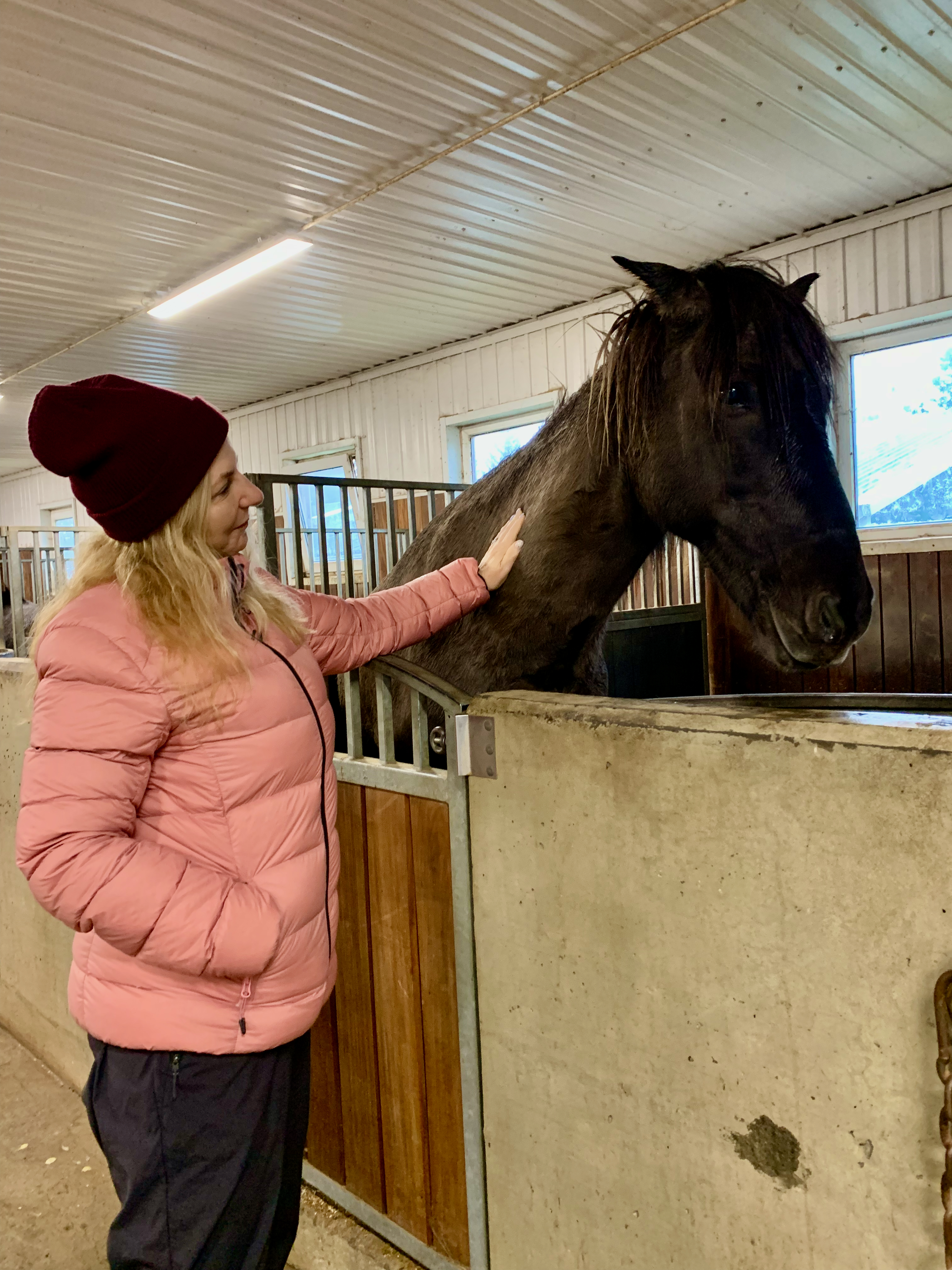
After lunch we watched a brief Icelandic horse show, then had an opportunity to meet a few of the horses up close. It was pretty interesting to see their 5 gaits. The tolt was like a very fast walk and incredibly smooth. This was demonstrated when 2 riders were able to ride with full mugs of beer, pass each other and clink glasses without spilling a drop. The flying pace demo was very short as the horse literally flew by in seconds. I had a nice friendly moment with one of the horses after the show.


Our final stop was Thingvellir National Park. Thingvellir literally translates to Assembly Plains and is part of the Atlantic Ocean ridge. The Althing General Assembly was established there in 930 AD, one of the oldest parliaments in the world. The first Icelandic Prime Minister was sworn in there, in 1944 in the pouring rain.
Final random tidbits and observations
- Total distance travelled: 2499 kms
- Coldest day time temperature: -6 C
- Warmest day time temperature: +12 C
- The Icelandic flag is blue (water), white (ice) and red (lava).
- My husband refers to me as a free-range sitter. This makes sense as I often bounce from one side of the bus to the other to get a better view or grab a photo. It is hard for me to be still for long periods.
- Call out to Chad for my evolving capabilities with barbell squats. Strong quads helped me navigate some of those very chilly outdoor washrooms with even colder toilet seats.
- I swear that 50% of the cars in Iceland are white. Sometimes there would be 10 or 12 in a row in parking lot.
- Somewhere near Vik (I think) there is a woman who is known to hang nice bras on her fence along the main road. They are free for the taking. She is a breast cancer survivor. There were none there the day we passed, but I so appreciated the thought.
- The highway sign for a rest area shows a picnic table and a tree. The sign is attention grabbing, while also ironic as there are so few trees in Iceland – and almost none at rest areas. The picnic tables are real.
- Icelandic seasons are described as 8 months of winter, 1 day of summer and the rest is spring and fall.
- I have had to cast aside my old habit or worrying about being too warm. By midway through the trip I realized that wind, snow and rain kept me perpetually cold. This resulted in some adjustments to my wardrobe. I added long johns under my pants, typically wore 4 layers on top (long sleeved shirt+down vest+down jacket+raincoat), plus a toque. and gloves. That seemed to suffice in most circumstances.
- Even some of the very smallest villages have a swimming pool, predominantly outdoors, with a hot tub (also called a ‘hot pot’) and sauna. The hot geothermal zones makes this easy as the water is naturally hot. Swimming is an essential life skill in Iceland.
- The universal sound of a tourist falling asleep on the bus: the thump thump of a phone falling out of a hand and hitting the floor.
- Most Icelanders speak 2-3 languages; English is typically one of them. Their English is so good, because much of their entertainment is provided by English-speaking countries.
- Iceland was one of the founding members of Nato.
- Cell service and internet really is everywhere. I always had 4 bars for my cell. In contrast, I currently have only 2 bars at this moment… and I am sitting in my living room.
- I loved this little fact. Turf houses were typically small, crowded spaces. Anything kept under your pillow was considered private and this was respected by everyone in the household.
- Most Icelanders would rather see a psychic than a psychologist.
- There are a surprisingly large number of golf courses. I imagine th biggest challenge is the high winds.
- 75% of babies are born to single parents. I am not exactly sure how to interpret that, but it is not a big deal to Icelanders.
- Hekla is one of the most dangerous volcanoes in Iceland and known as the entrance to hell. A man went close to the volcano to eavesdrop and learn what they talked about in hell. He did not understand a word – they were all speaking Danish (Not my joke but a little clever. Iceland was under Danish rule beginning in 1380 and part of Norway until 1814. In 1874, one thousand years after the first acknowledged settlement, Denmark granted Iceland home rule.)
- The worst thing that could happen to an Icelander who broke the law was to be outlawed and banished. This happened to Erik the Red; he relocated to Greenland.
- Iceland was originally pagan, then Catholic and now Lutheran. The church is funded through taxes, however, there is freedom of religion so anyone not wanting to pay the portion of taxes to the church can redirect it – to a university religious studies program.
- Fishermen are some of the wealthiest people in Iceland. Only 6% of the population works in the fishing industry. 10% are in farming and 79% in tourism. (I know the numbers don’t quite add up so I assume the remainder is some sort of misc…).
- Iceland is very expensive. An average annual income is $65,000 per year, though some people work 2-3 jobs to be able to earn that much.
- Although Iceland was a neutral country during WWII, they were invaded by Britain in May 1940. There was concern about Nazi Germany invading Iceland after they had overrun Denmark.
- Icelanders are not allowed to carry guns. There are 100,000 guns in the country, primarily used for hunting. Even the police. do not carry guns though there is a SWAT team that has guns if needed. For some reason, if Icelanders end up with a gun, they like to shoot them from their balconies.
- The Icelandic word for Iceland is “Island”. That’s kinda cool right?
Iceland was a truly wonderful adventure. It is filled with history, beauty, magic, wonderful people, delicious food and more outdoor clothing shops than most of us might ever need. We embraced it all – weather permitting or not.
Finally, no adventure would be complete without a call out to my husband and partner in crime. He is the one who understands, and indulges, all of my impulses, weird travel habits and idiosyncrasies. May we have many more adventures together.


 Adventures of a curious mind
Leave a reply to Brenda Mills Cancel reply