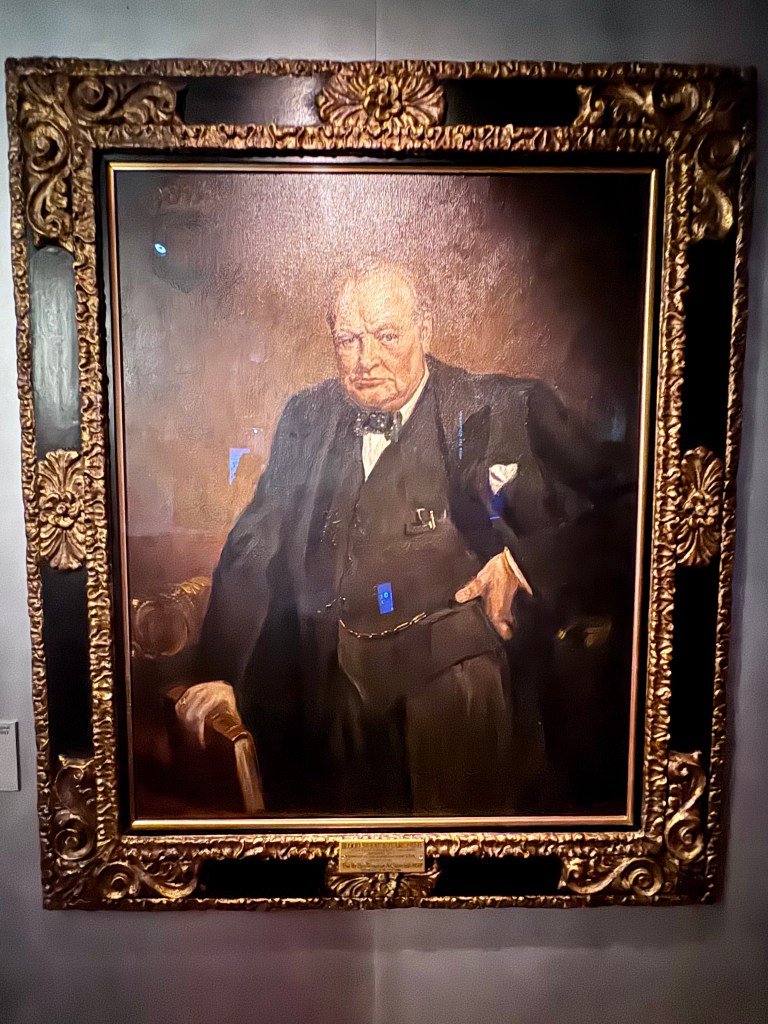
We were up early and out of the hotel in no time; we had an early date with Winston at the Churchill War Rooms and did not want to be late.
I was dressed for an entirely different day than the one we stepped into. My skirt, short sleeve t-shirt and light sweater would have been very appropriate for the 25 degree day that was forecast. In actuality, something longer and thicker, or perhaps a parka, would have been a better choice. The day began as overcast with a distinct chill in the air and a steady breeze. I warmed up once we got walking… sort of… or perhaps I just decided to stop whining about it.
The 20 minute walk to The Churchill War Rooms offered us a few iconic views along the way including, in no particular order: Charing Cross, the Nelson Monument in Trafalgar Square, the Police Memorial, St James Park and The National Gallery.
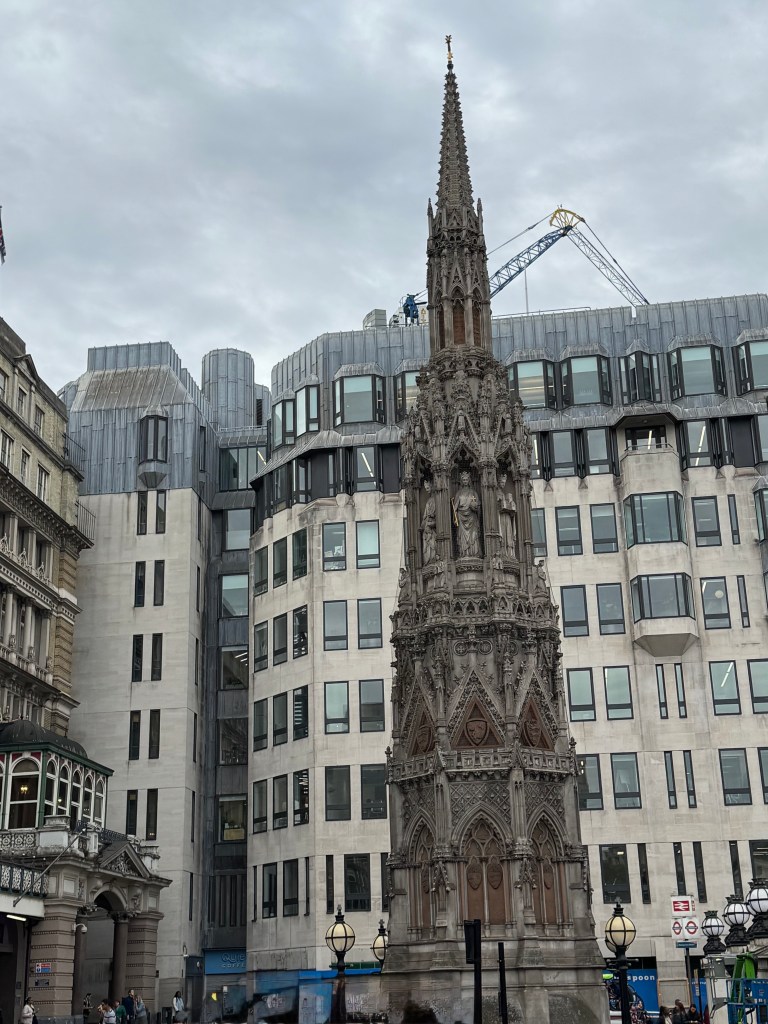
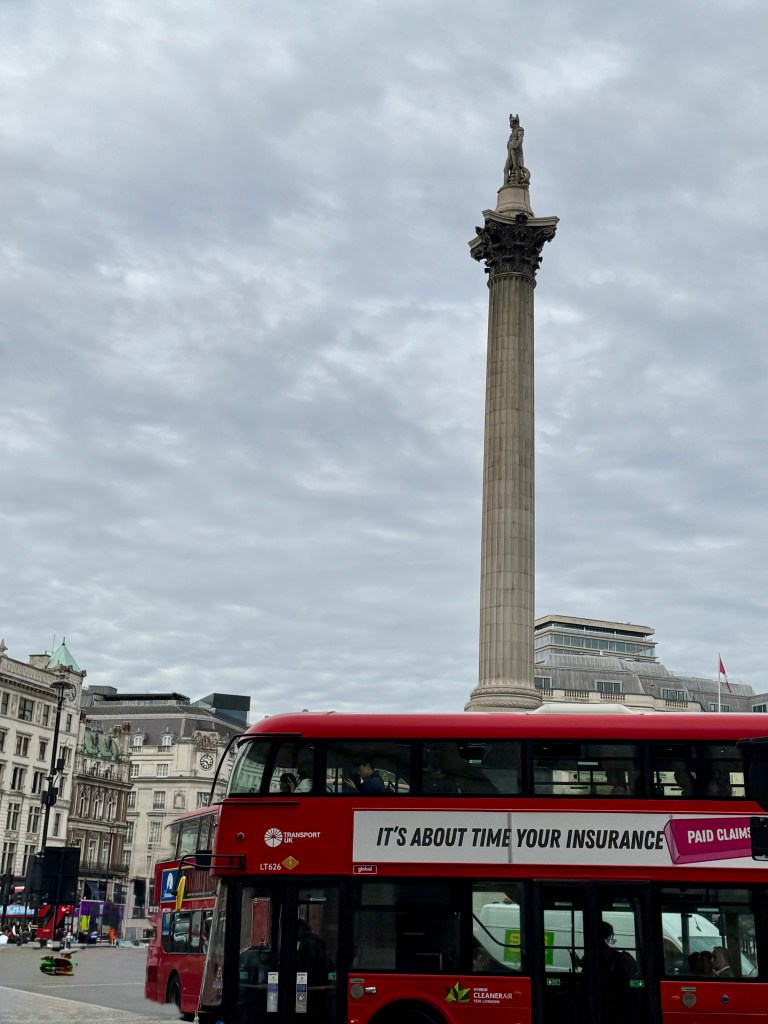
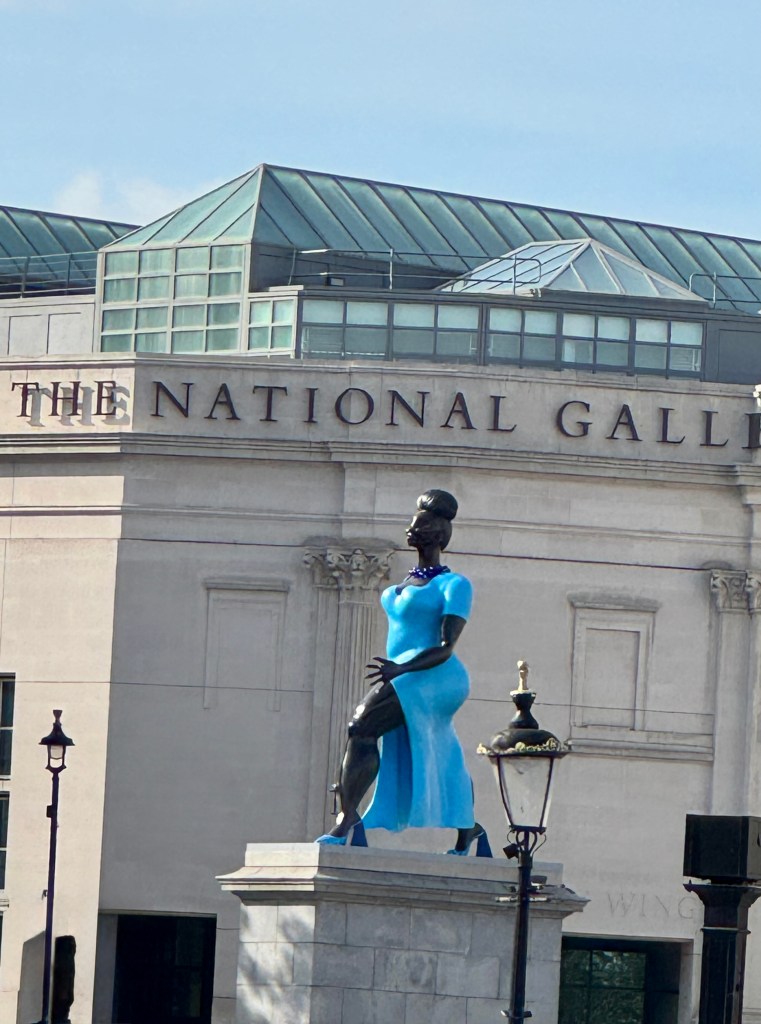
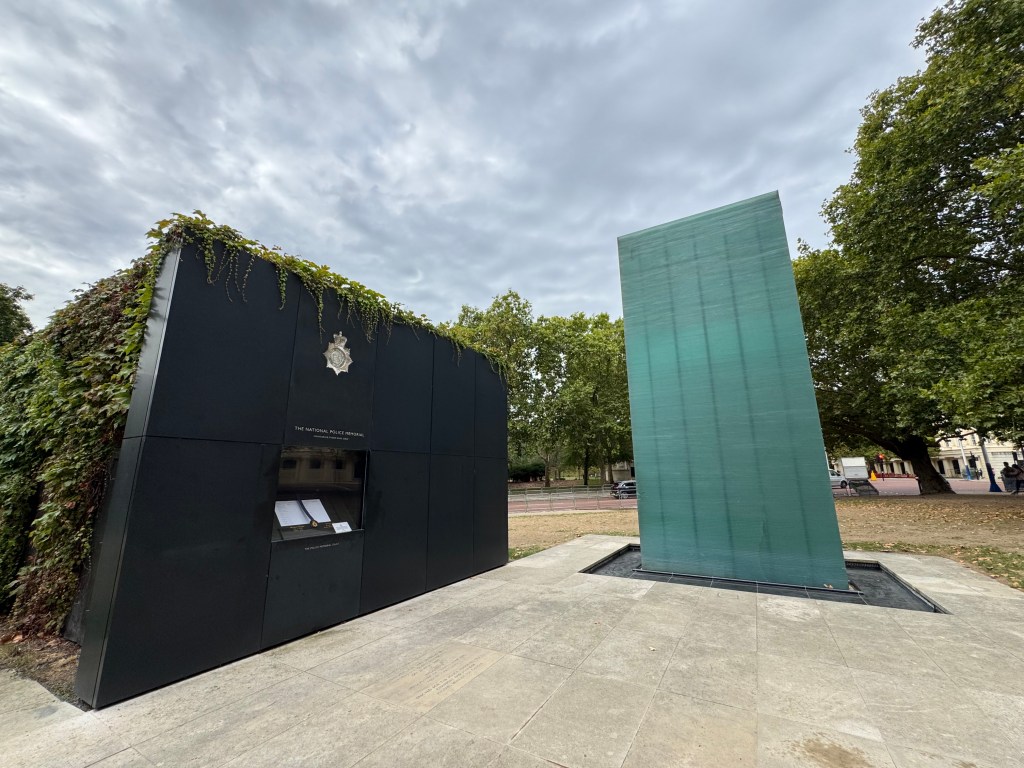
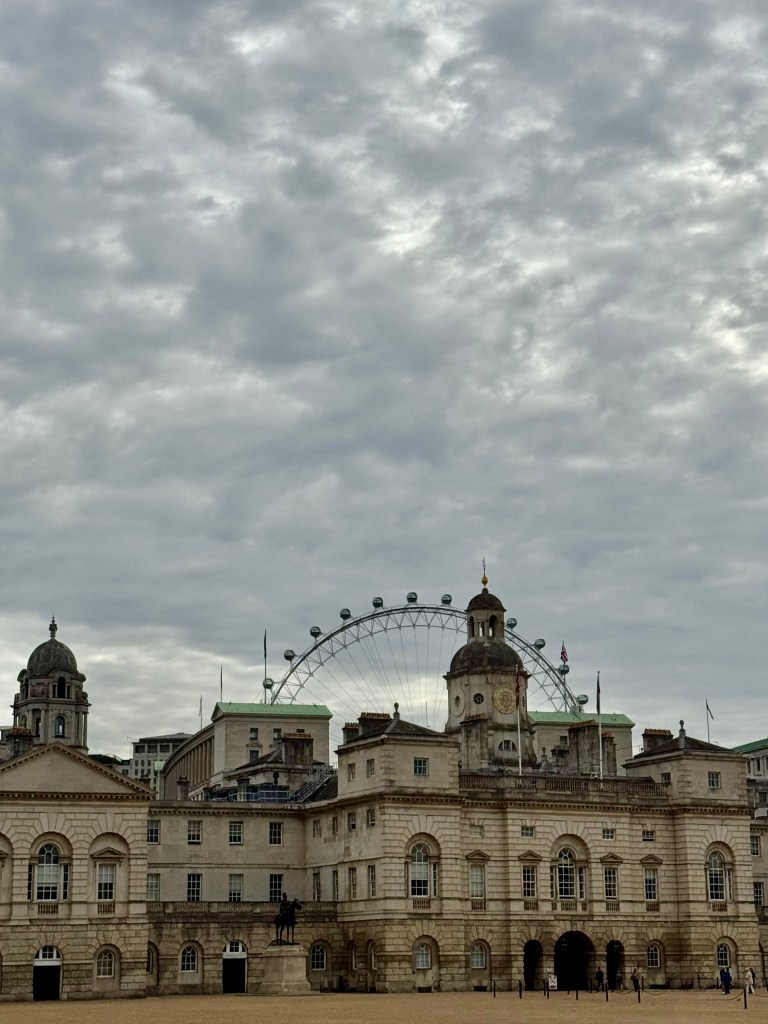
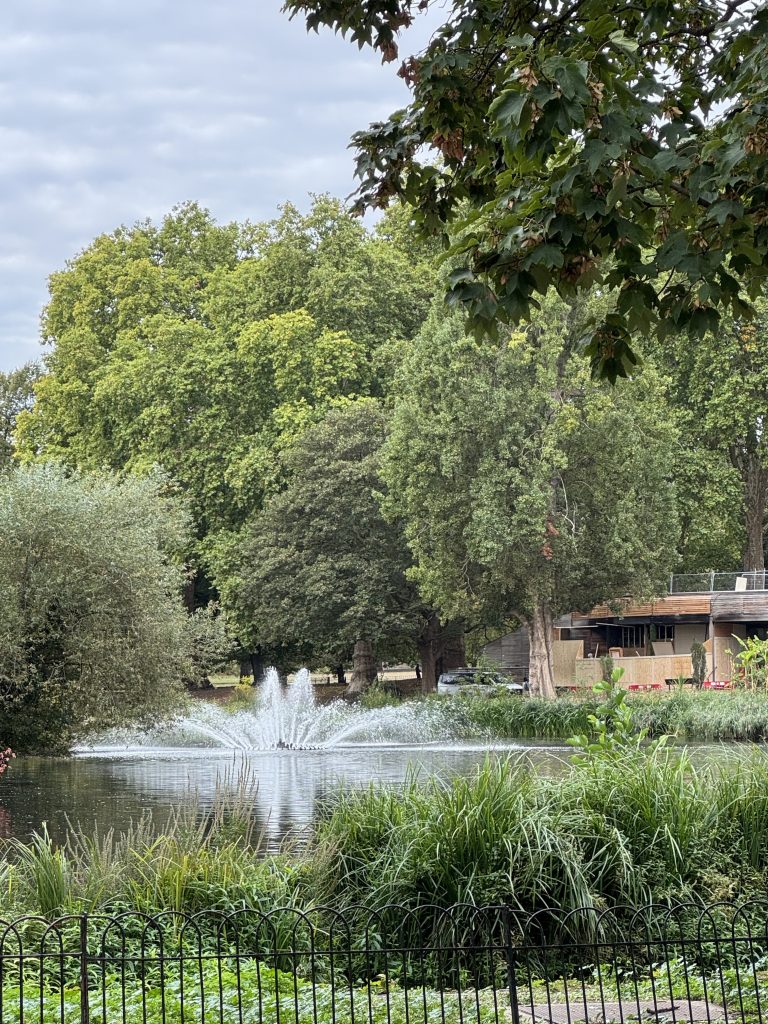
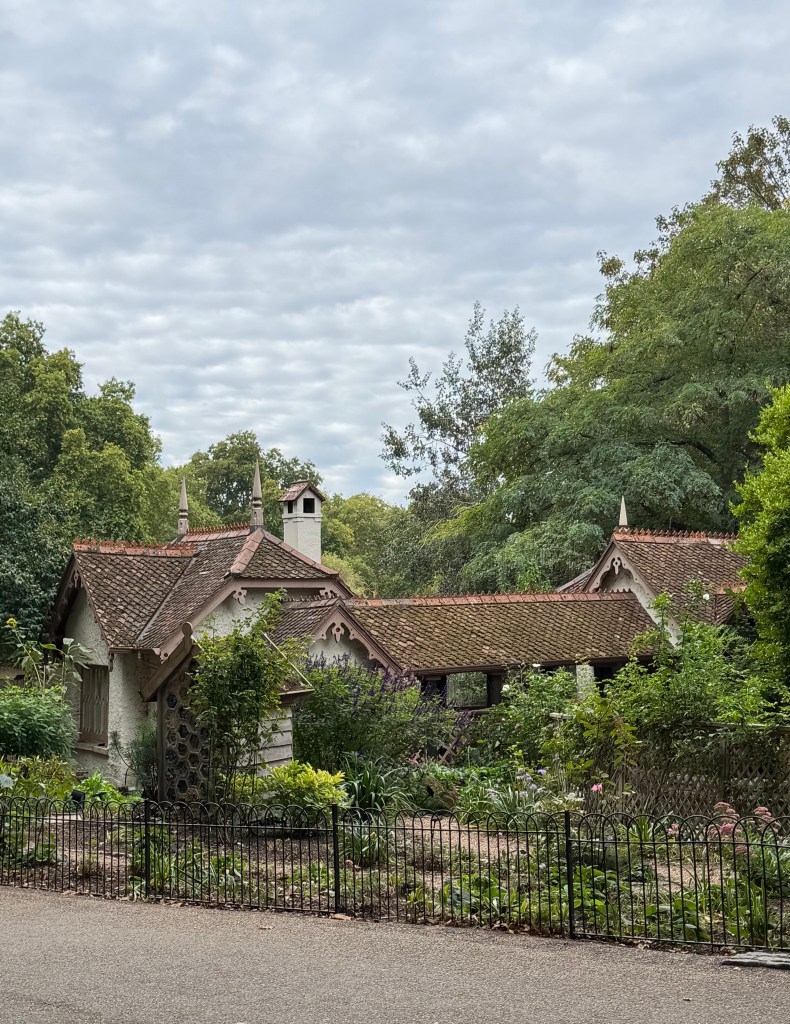

I was particularly taken with the National Police Memorial, honouring 4,000 officers who lost their lives in the line of duty spanning more than 340 years – the entire period history of British policing. The number is astonishing considering the size of the population (70 million) and that 96% of police officers do not carry guns. The other 4% are granted weapon exceptions. Due to the long and complex history, only officers in Northern Ireland routinely carry guns.
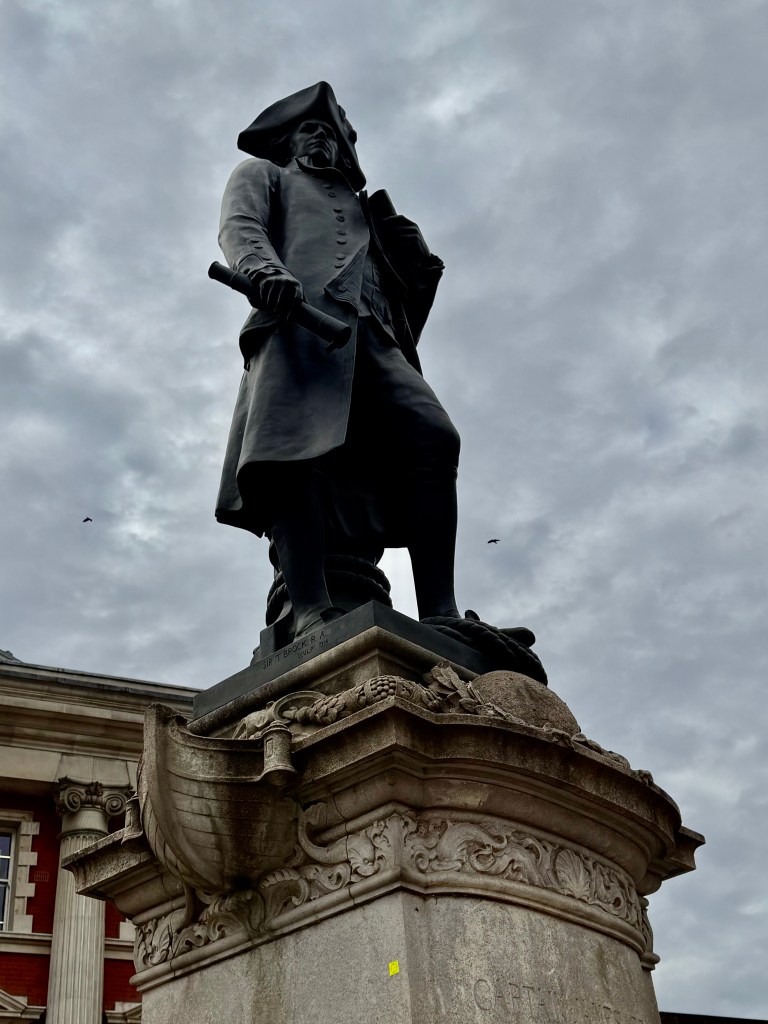
We passed a statue of Captain James Cook just outside St. James Park. I have a warm spot for Captain Cook after reading about his travels in the 6th grade. My interest was so great that I build a model of his most famous ship The HMS Endeavour out of Popsicle sticks and tooth picks c/w rigging and sails. This project was for my own interest, not as a required school project. I was very good at being producrively busy even then.
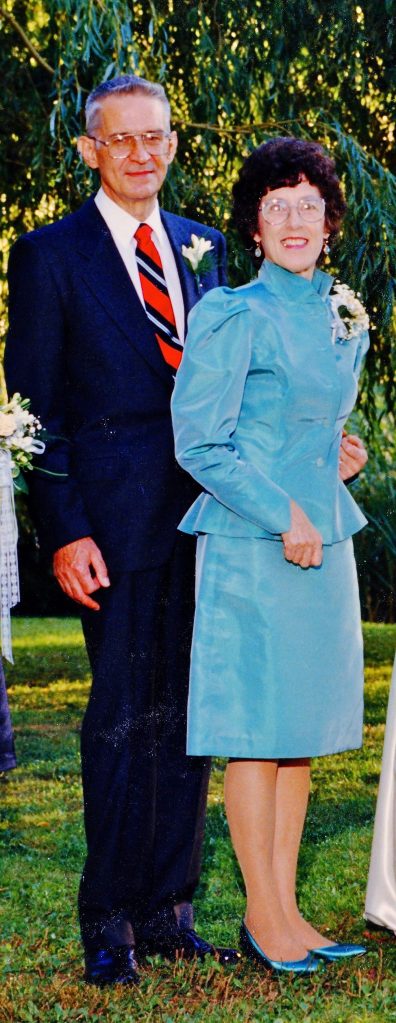
As an aside, I also used a bunch of my mother’s fabric to create an Elizabethan gown that same year. It was made particularly challenging by her explicit requirement that I not actually cut any of the fabric. Mom ended using the main fabric, a beautiful iridescent turquoise, to make the suit she wore to my first wedding.
(My ability to digress has now exceeded all expectations. Now where were we? Ah yes! Back to the Churchill War Rooms.)
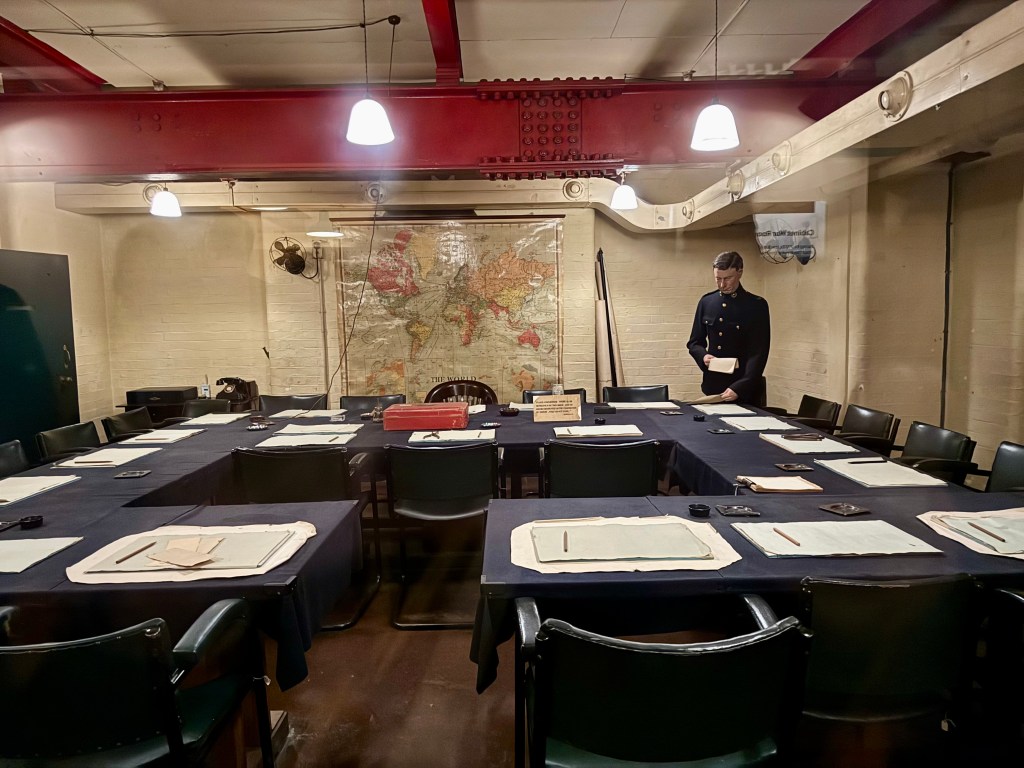
The Churchill War Rooms are a historic underground bunker complex in Whitehall. It served as the primary command centre for the British government during World War II. The space was protected, at least theoretically, under strong girders, steel plating and concrete.
During the core 8 months of the blitz alone, 1,400+ bombs were dropped directly inside the Borough of Westminster. The closest bomb struck only a few feet from the entrance, leaving a large crater in King Charles Street. Looking at it now, it does seem that a direct hit would have done serious damage.
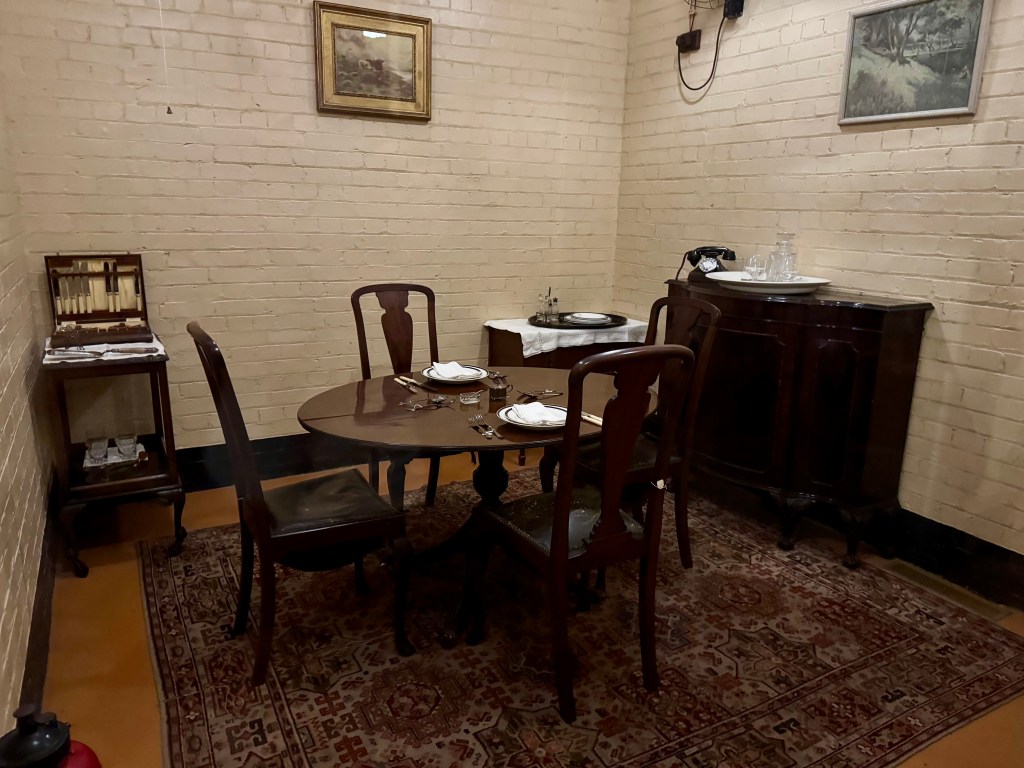
Hundreds of strategists, typists, switchboard operators and military officers worked, and sometimes lived, within the claustrophobic space, with no daylight. Poor water access, no sewage system (they used chemical toilets) and air filled with cigarette and cigar smoke made conditions even worse. It imagine it wold have seemed much like serving in a submarine.
There was a fully equipped kitchen, and a cook as well as beds in a room entered through a doorway in the floor and a ladder. The beds were rationed and shared via a rotation system. Staff often worked hundred hour weeks and slept when they could.
A member of the staff posted the weather several times a day. The lack of exposure to sunlight created severe vitamin deficiencies which they tried to manage with sunlamps. Churchill disliked ambient noise. The phones were equipped with lights so they did not ring. The staff were required to move about as quietly as possible , often difficult in the cramped and crowded space
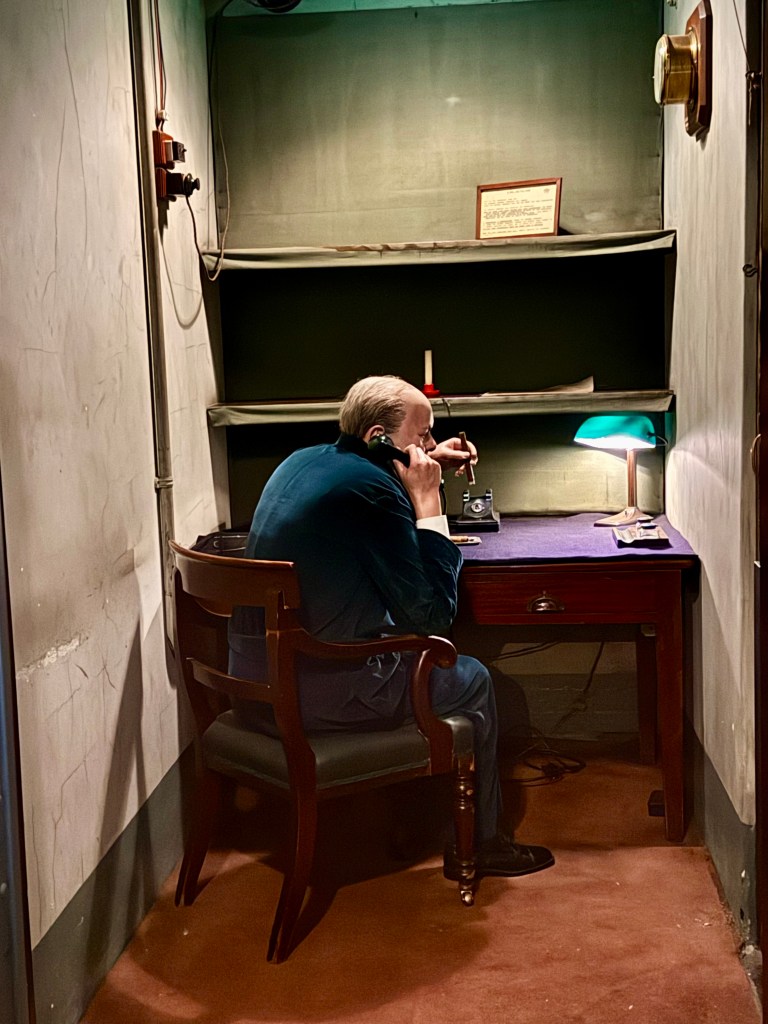
The very existence of the bunker was a secret, let alone the work what was done there. Strict security levels were in place, with increasing requirements for particular areas such as the map room. Only Churchill himself had access to the phone room that had a direct line to U.S. President Roosevelt. A top secret scrambling technology was employed on the calls.
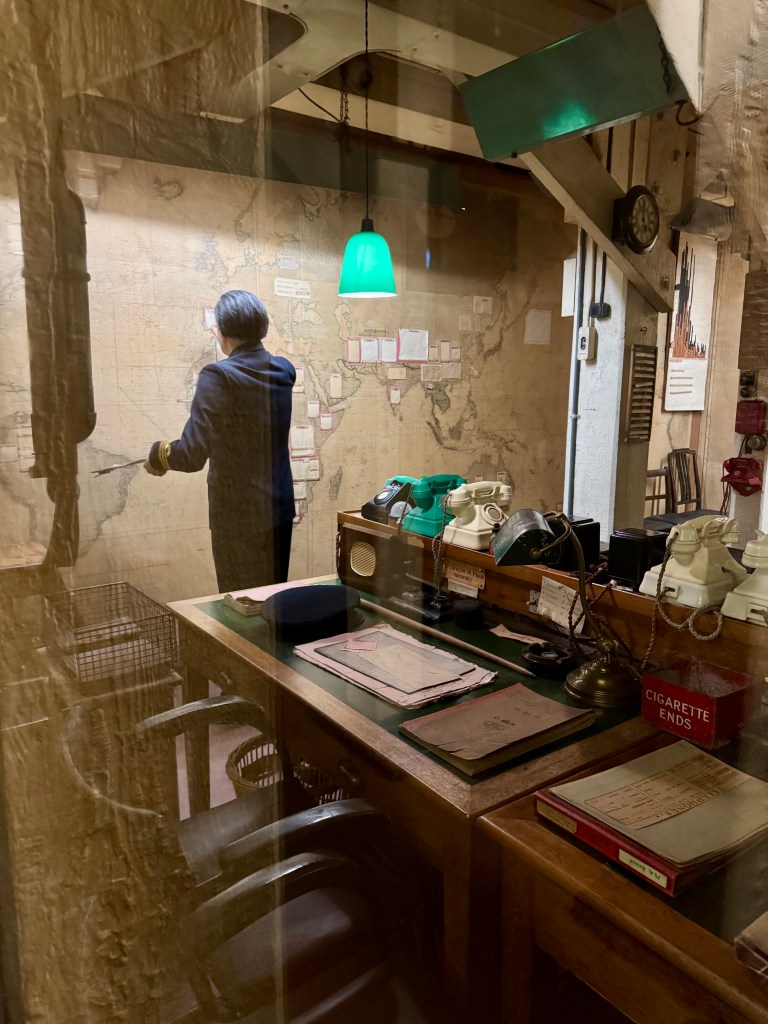
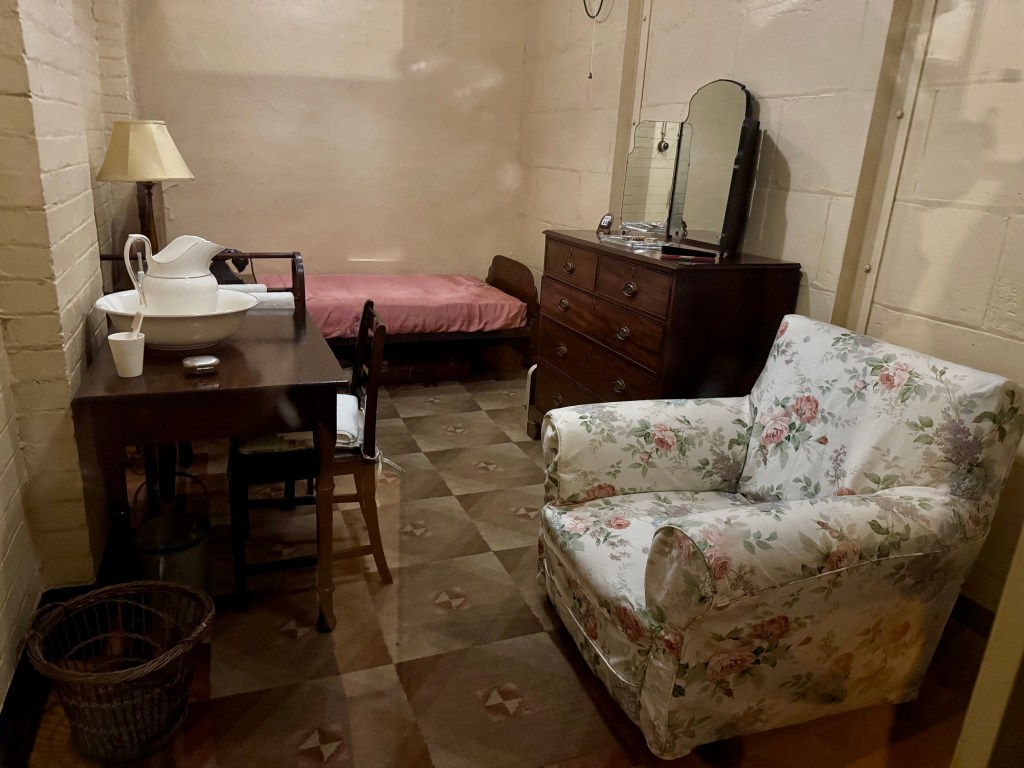
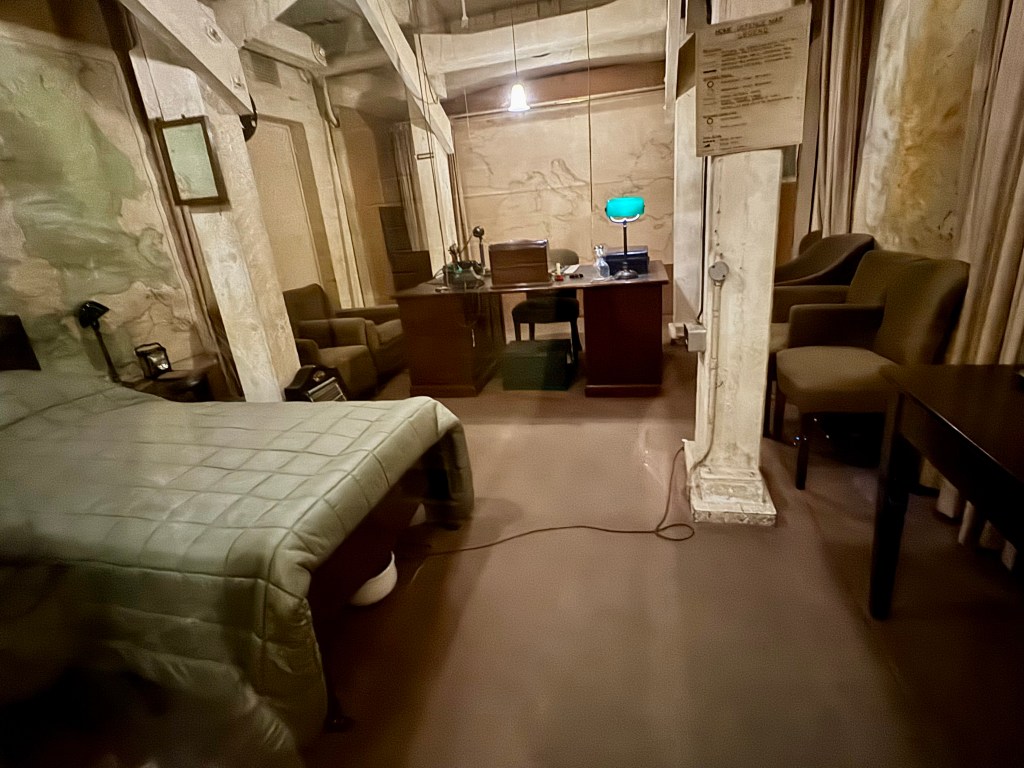
Churchill was described as a challenging man to work for. He was demanding and difficult at times, yet there are many positive quotes from the staff about Churchill and his leadership. They knew that what they were doing mattered, and there was no one they would have rather worked for.
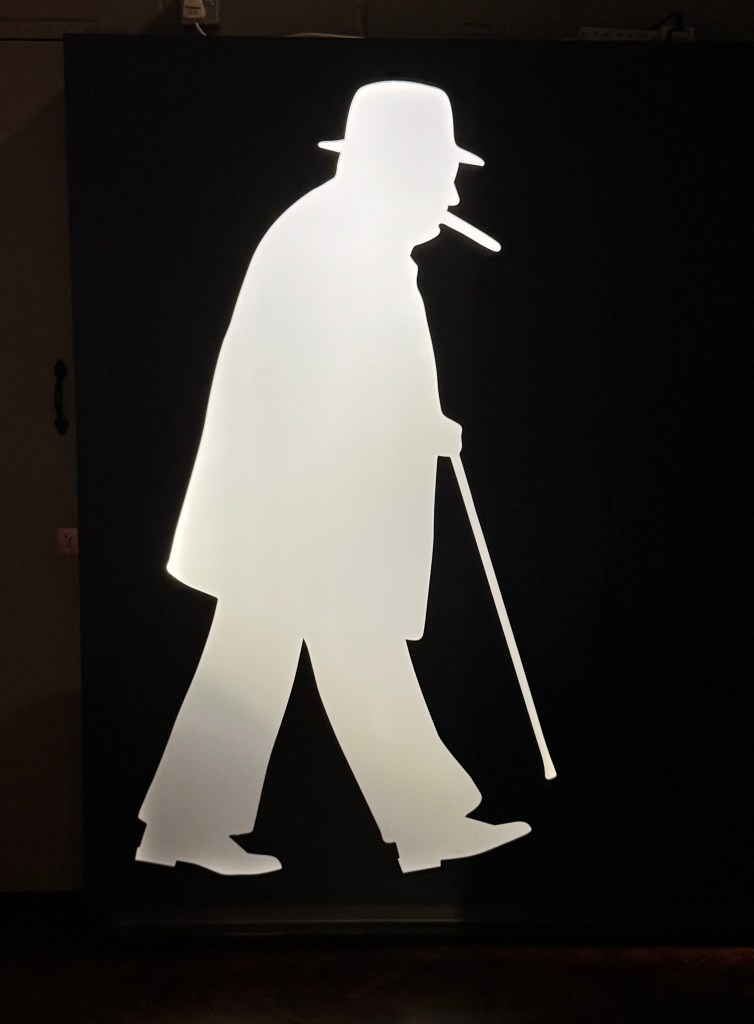
Churchill rarely work early, spending the first 3-4 hours of each day working from his bed. He would read the newspapers and latest intelligence maps, dictate top secret memos to his secretaries, and drink his morning tea. there. He would dress for a substantial lunch, then return to his bedroom for a 1-2 hour nap. Churchill considered this essential to maintain his stamina. He often held meeting in his bedroom before or after his nap. He smoked 8-10 cigars a day, and drank champagne and whisky at every meal.
A classic night owl, Churchill frequently scheduled the official War Cabinet meetings to start as late as 10:00 p.m. or even midnight. When he needed to consult with his allies, he would step into a tiny room, disguised as a private toilet to make the call.
The bunker was used continuously, 24 hours, 7 days a week for 6 years beginning in August 1939, one week before England declared war on Germany. The last cabinet meeting took place in March 1945. With German bombing no longer a threat, Churchill and his ministers moved their daily strategy meetings above ground to the House of Parliament. Though hundreds of military and support staff stayed behind to manage the war in the Pacific.
On August 16, 1945, the lights in the Map Room were switched off for the first time in 6 years. The war was over and the staff were ready to return to their lives – whether civilian or military. They packed their personnel possessions and walked out into the daylight.
Rather than clearing the rooms, the doors to the Cabinet War Rooms were locked and sealed shut. Everything inside was left untouched: maps kept their coloured pins, phones and papers remained on desks, everything was frozen in time.
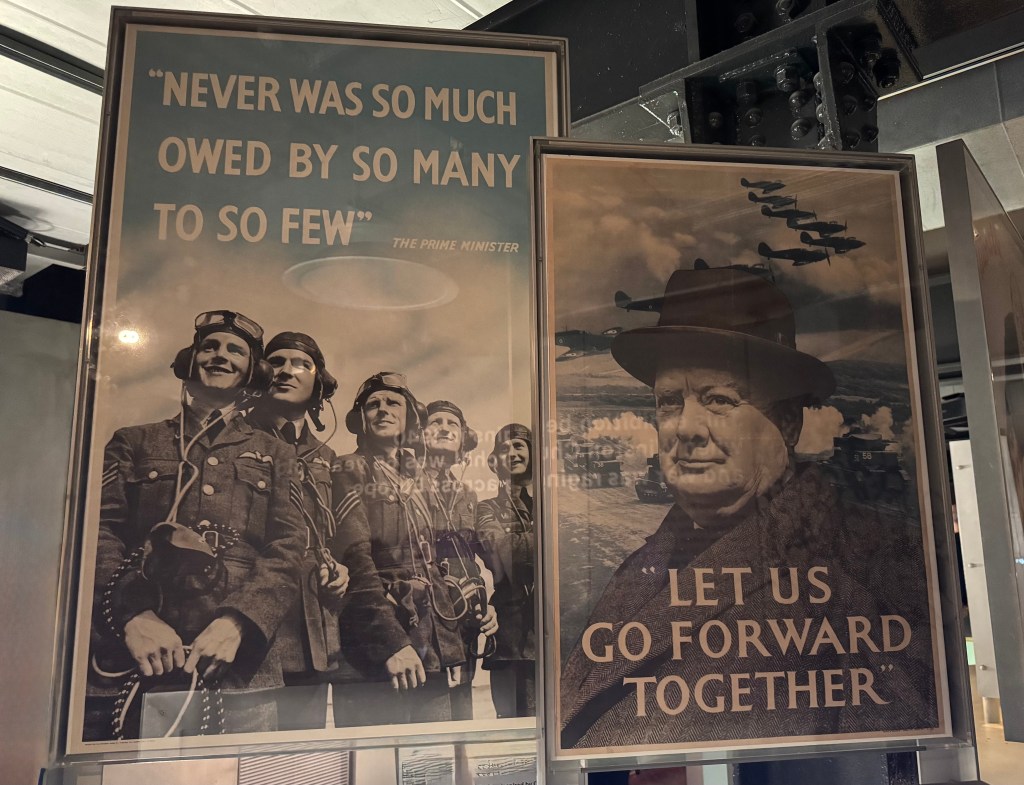
The bunker remained that way and was mostly forgotten for almost 40 years, disturbed only by occasional top secret government maintenance checks and perhaps a VIP visitor.
The War Rooms were re-opened and given to the Imperial War Museum. in the late 1970’s. After careful preservation efforts, the museum officially opened to the public in 1984.
Winston Churchil was Prime Minister until shortly after Germany surrendered. The coalition government that had supported him throughout the war dissolved. He was in Germany, helping to negotiate the post war structure of Europe when the election results were announced; Clement Attlee’s Labour Party had defeated Churchill. He resigned immediately, Attlee was leading the war effort when Japan surrendered in August 1945. This was a huge disappointment for Churchill who had wanted to see it through to the very end.
The general consensus among British voters was that while Churchill was an exceptional leader for winning a war, while Attlee was considered better suited to rebuild a post-war Britain.
Churchill first became Prime Minister at the age of 65. Now that is an inspirational 3rd act. He had a wife and 4 children who supported him and were active in the war effort.
He was re-elected as Prime Minister in 1951, at the age of 76, resigning 3.5 years later due to ill health. Churchill died in 1965 at the age of 90. Granted a state funeral by Queen Elizabeth, he lay in state for 3 days at St. Paul’s Cathedral. 320,000 people braved freezing weather to file past his coffin and pay their respects.
My mother lived through the war. Her father served in Britain, returning to serve in Canada near the end of the war. She spoke of it often – the rationing and the loss. Though still a girl. she contributed by dancing in service shows. My father never talked about the war. I wish I had asked him about that….
It was a strange, disoriented feeling to come out of that place and back into the sunlight. We sat together in silence for a little while, collected ourselves, then walked away into the sunlight.
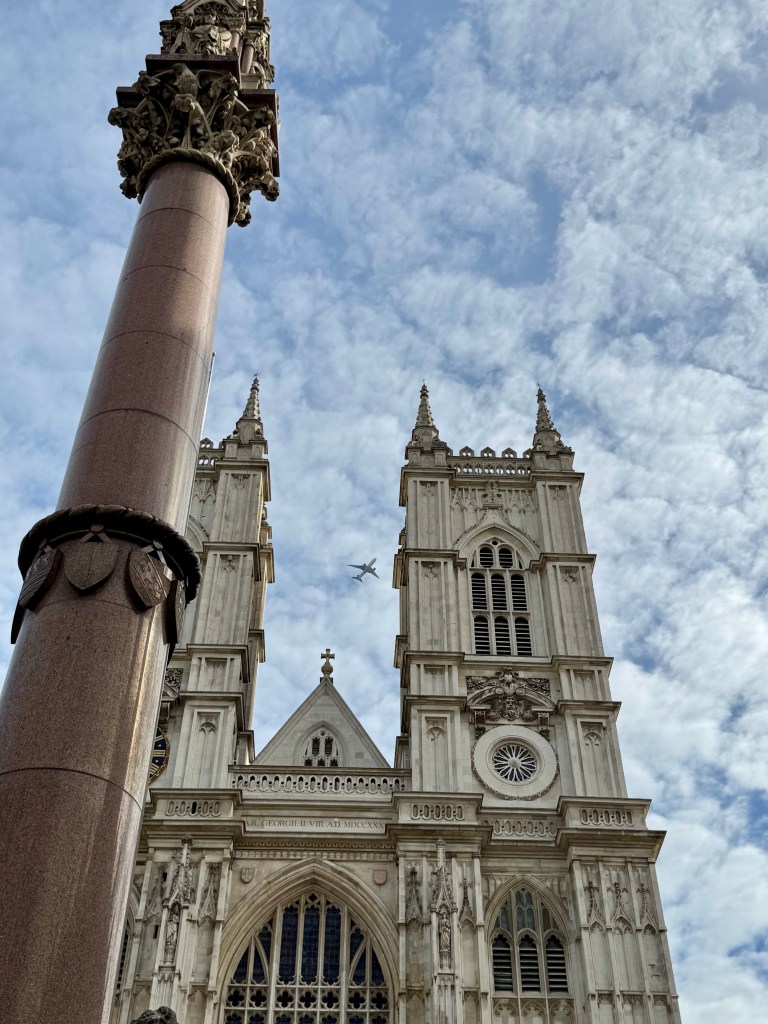
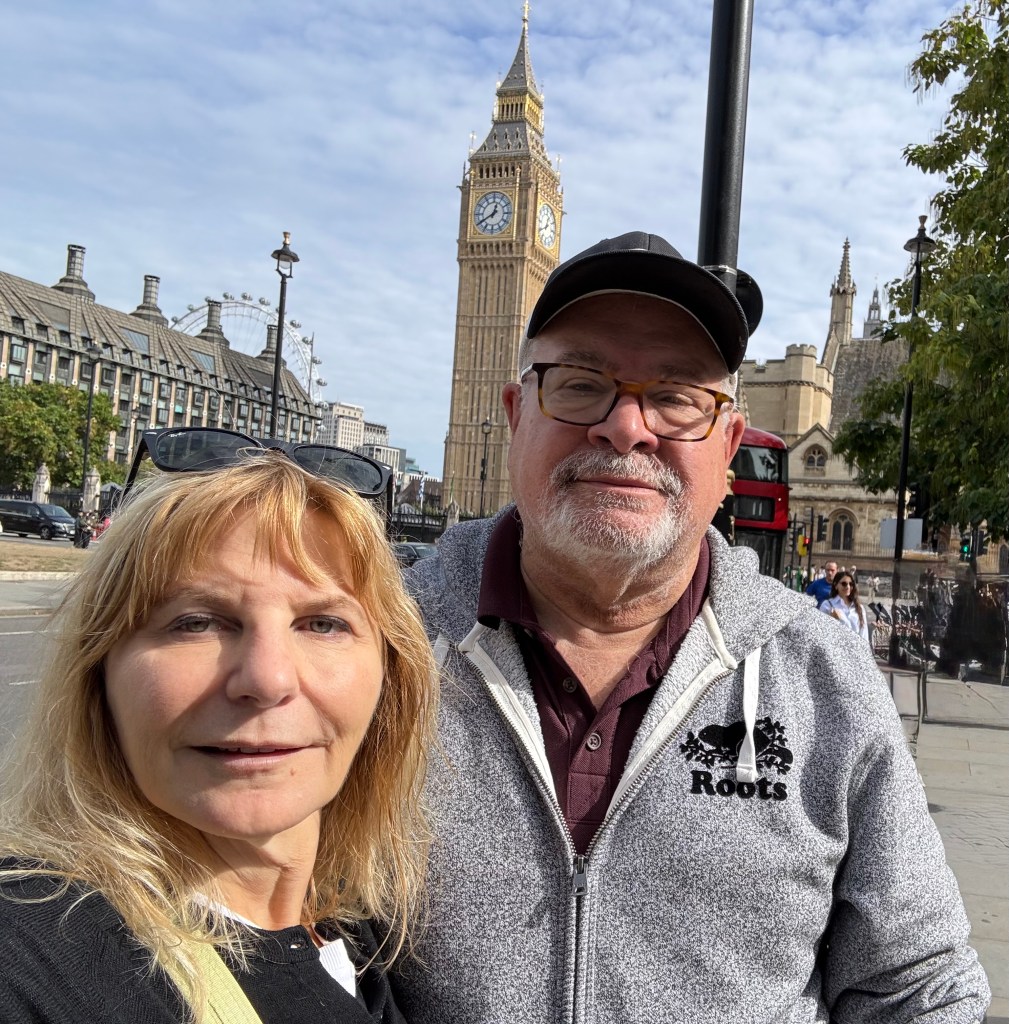
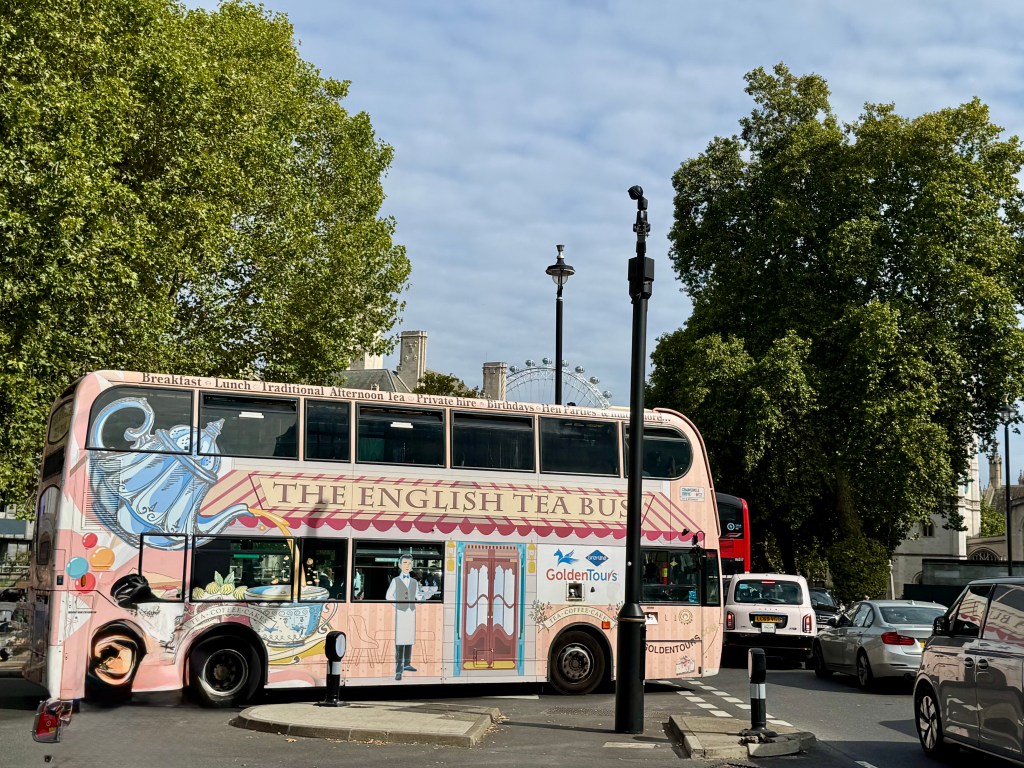
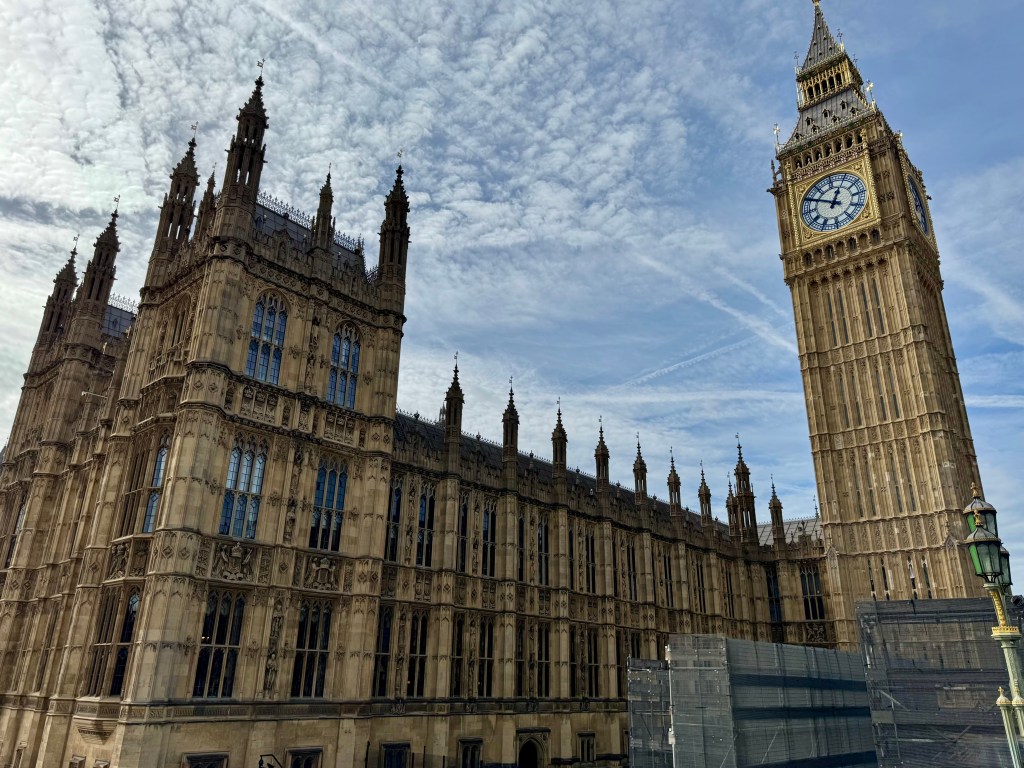
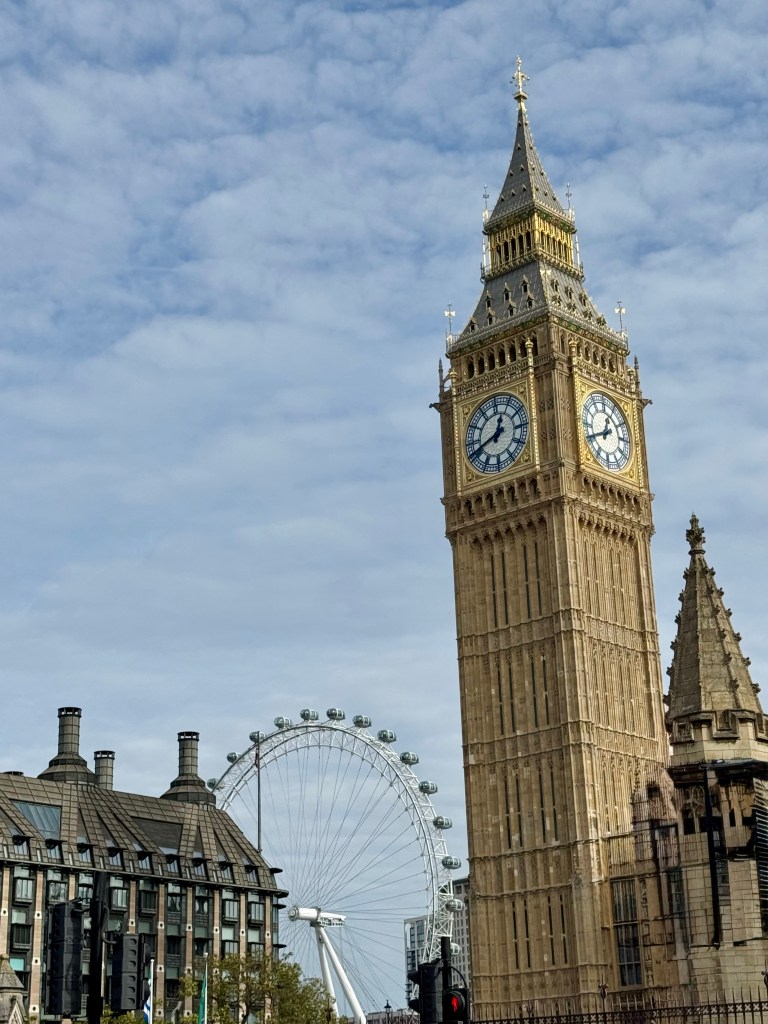
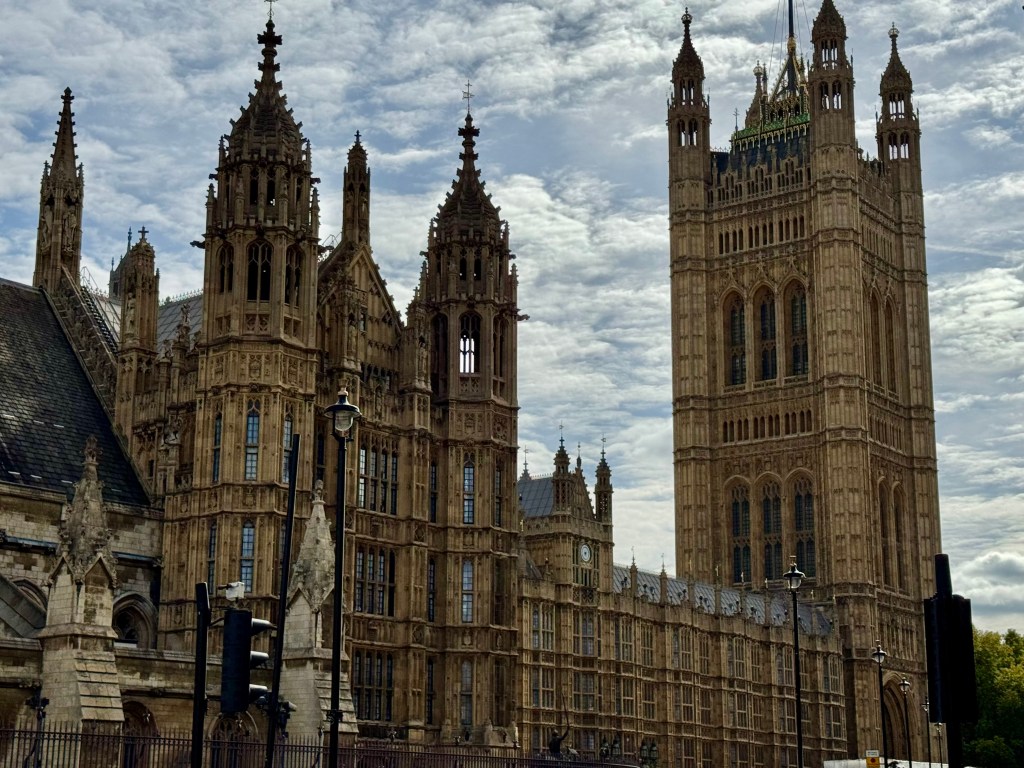
Later that afternoon we spent 2 hours in Westminster Abbey. It was amazing. The audio tool was excellent.
Westminster Abbey is classified as a “Royal Peculiar”. This means it is under the direct jurisdiction of the British Monarch rather than a bishop or archbishop of the Church of England. It is the primary setting for many of the monarchy’s defining moments.
There have been 16 royal weddings there, including Prince William and Process Catherine in 2011. Since 1066, all 39 Coronations have happened there. Thirty Kings and Queens are buried there, 17 of them monarchs. Their tombs are clustered around the Shrine of St. Edward the Confessor or in the Henry VII Lady Chapel. (The traditional burial site shifted to St. George’s Chapel in Windsor Castle following George II.)
The site where Westminster Abbey sits began as a modest Benedictine monastery around 960 AD. In the 11th century King Edward the Confessor built a grand stone church there, intending it to serve as his royal burial site. Two centuries later. Henry III replaced Edward’s church with the current Gothic structure. Henry VII added the Lady Chapel and the familiar western towers in the 18th century.
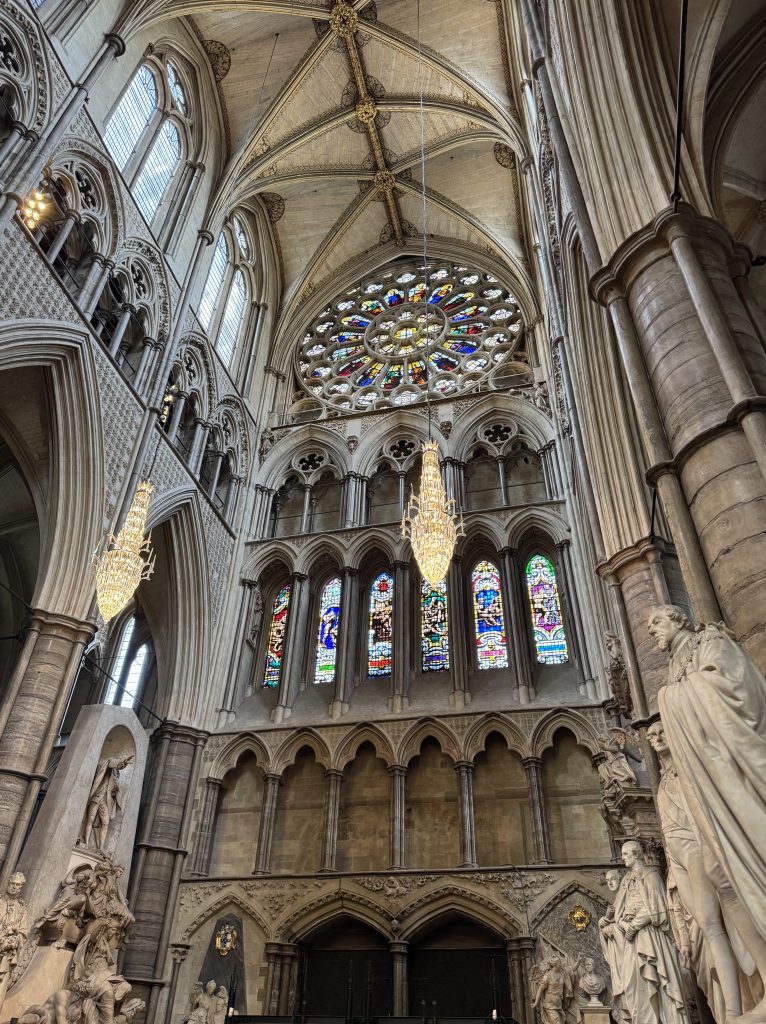
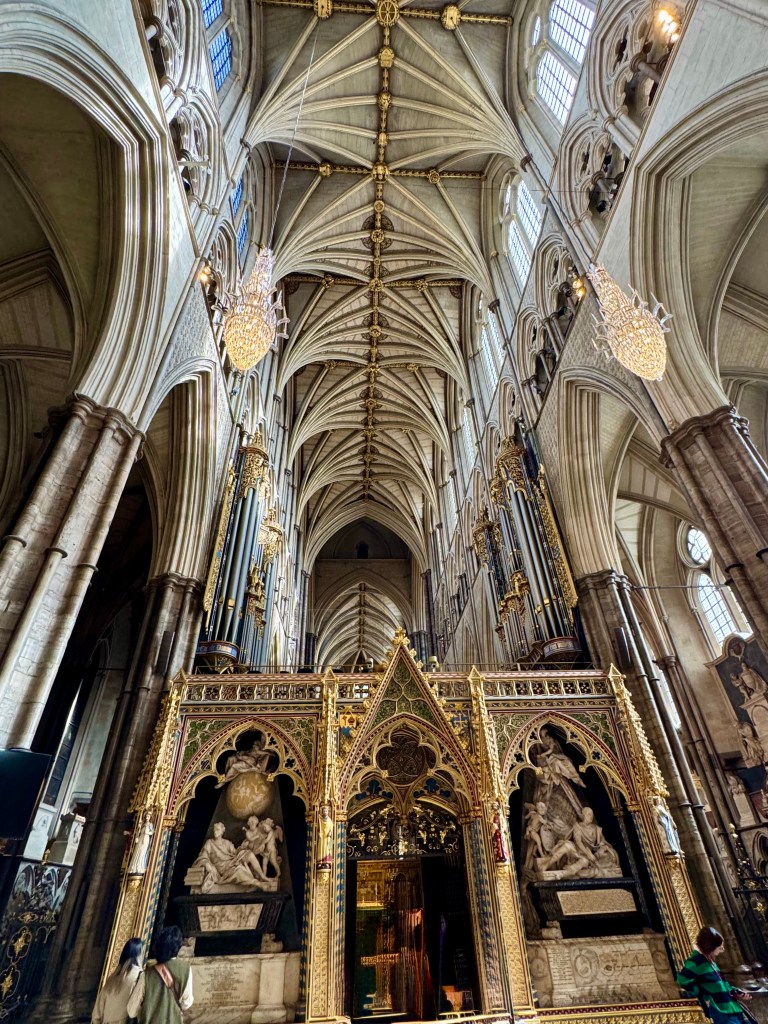
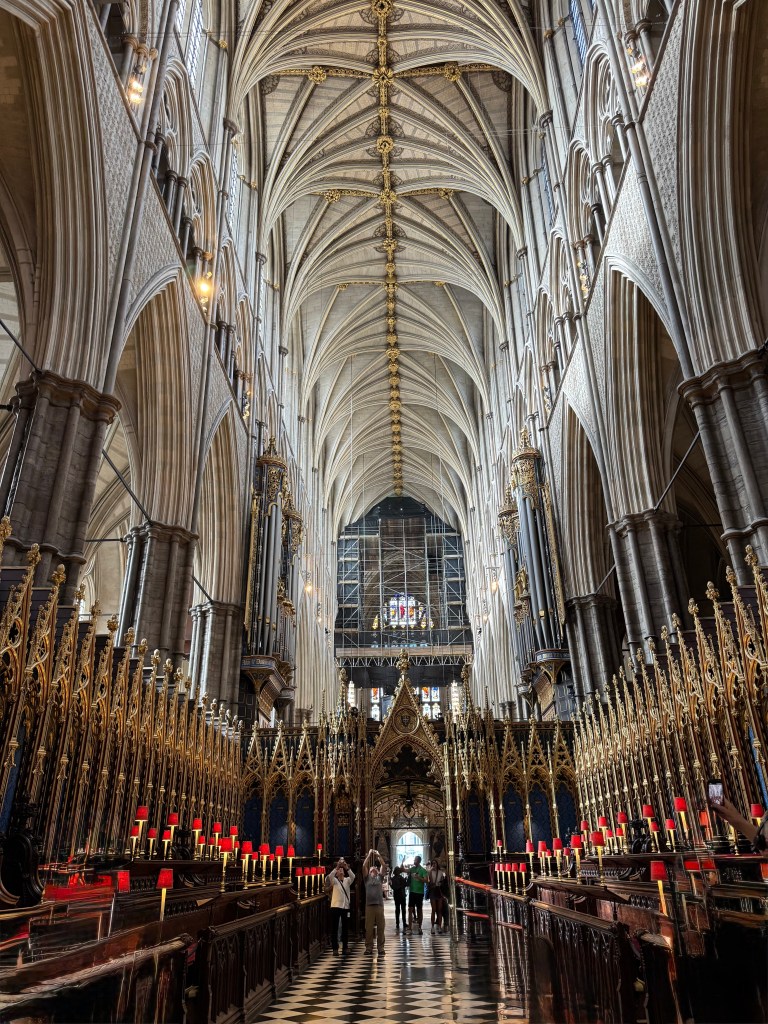
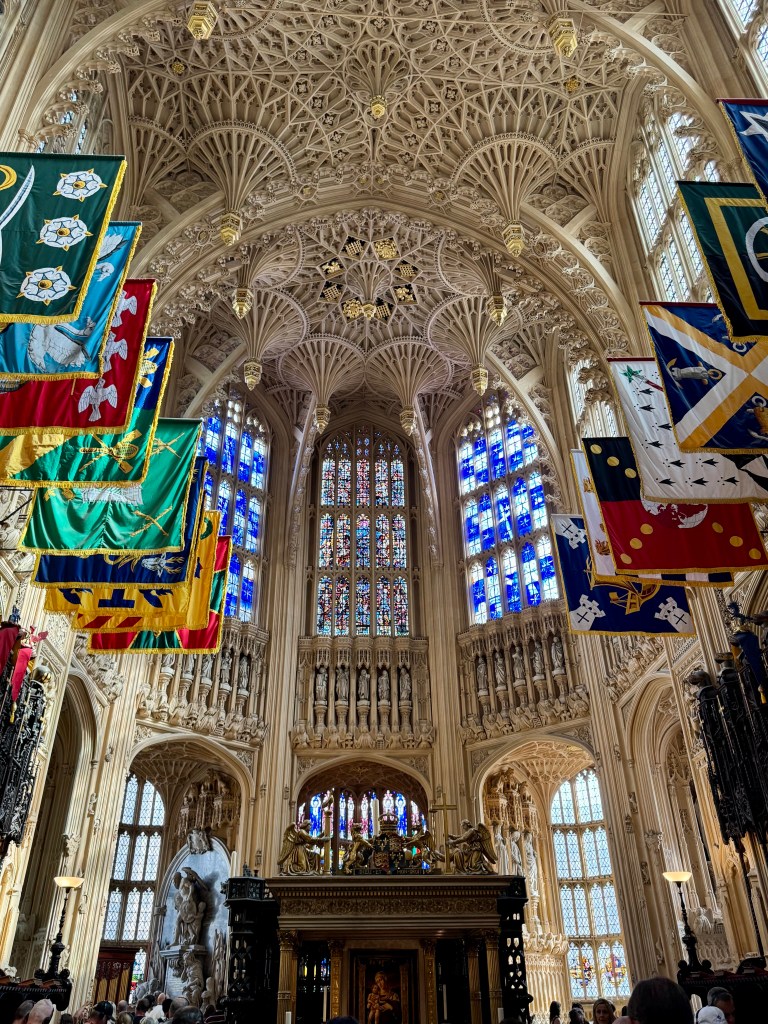
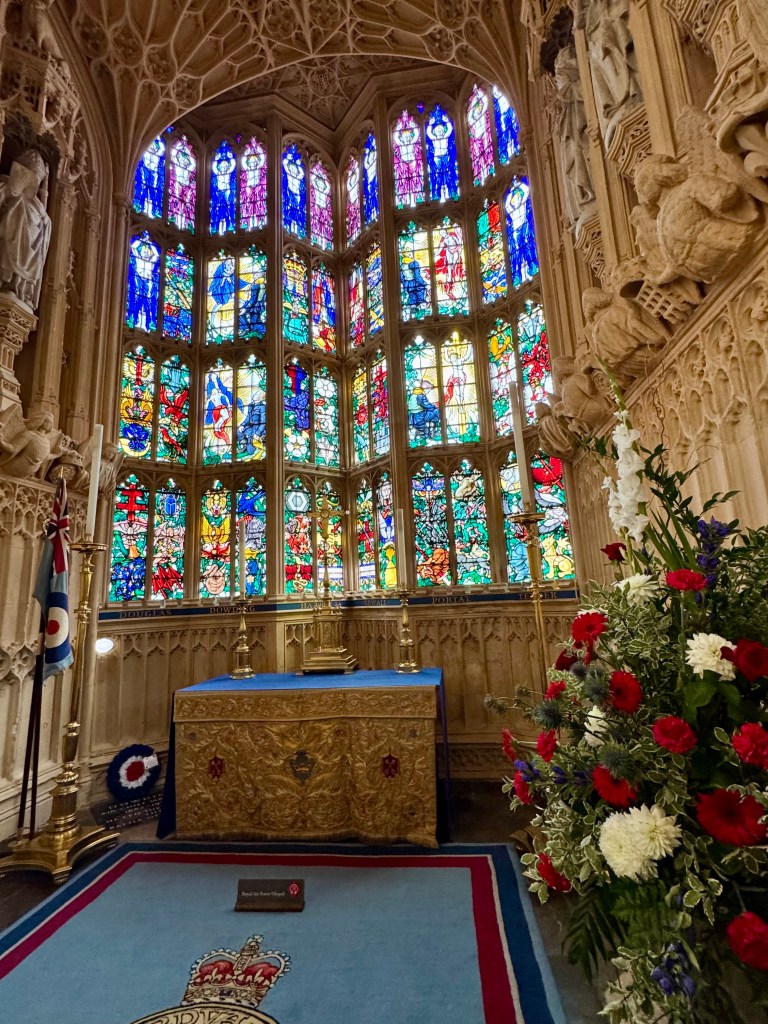
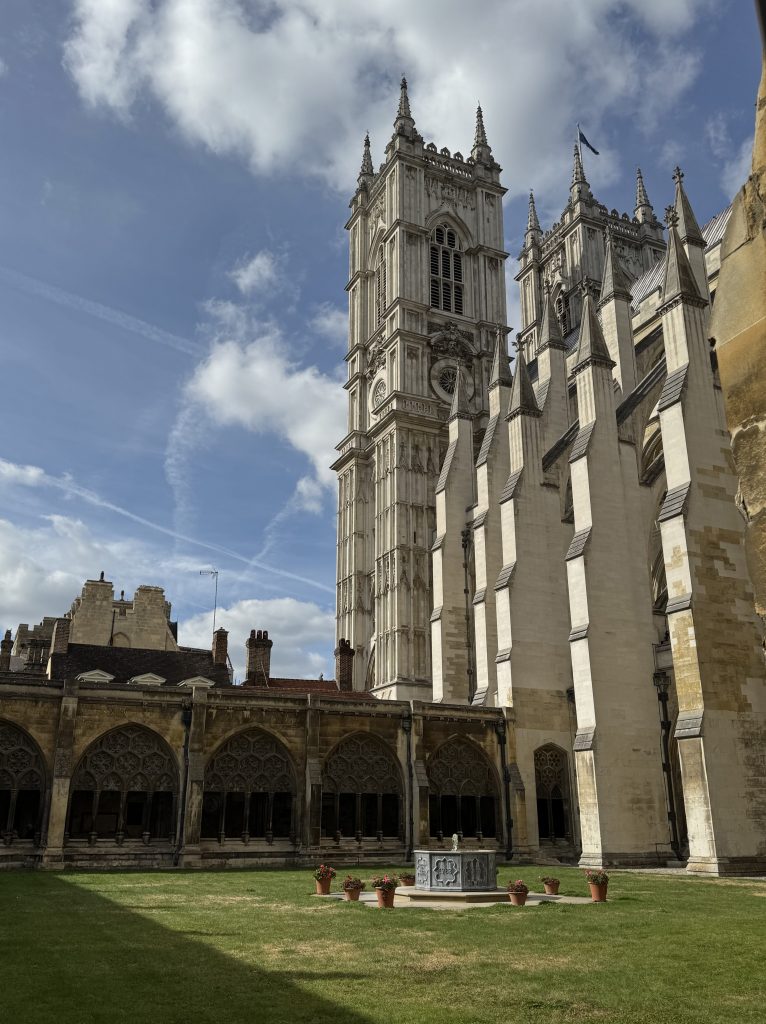
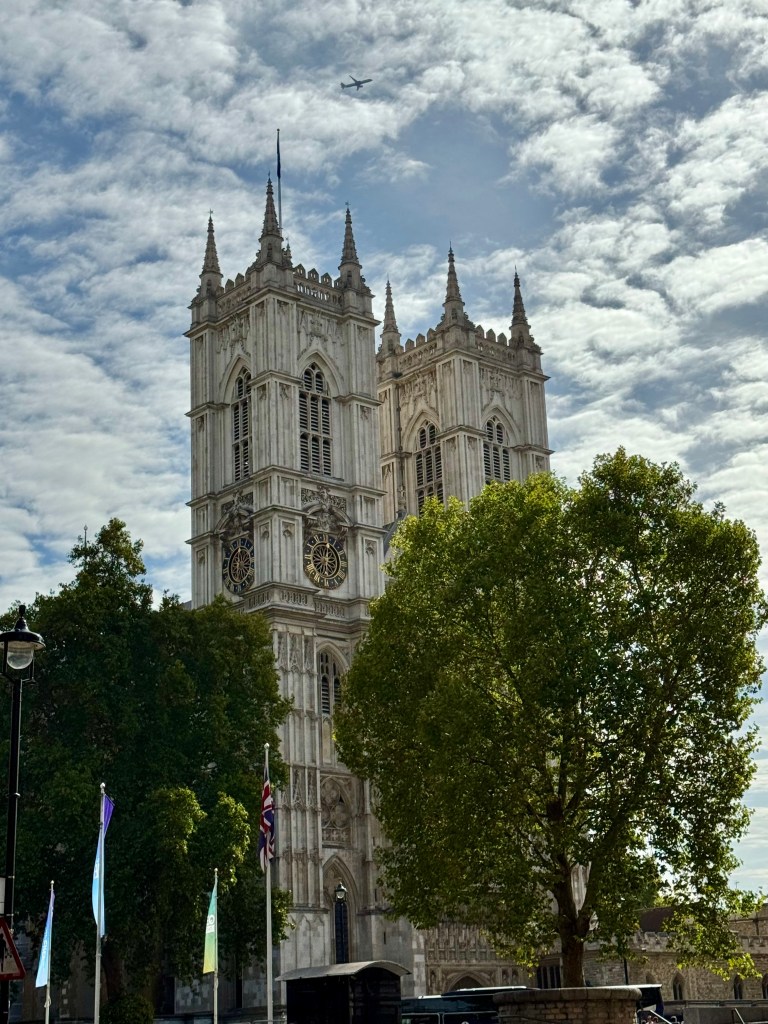
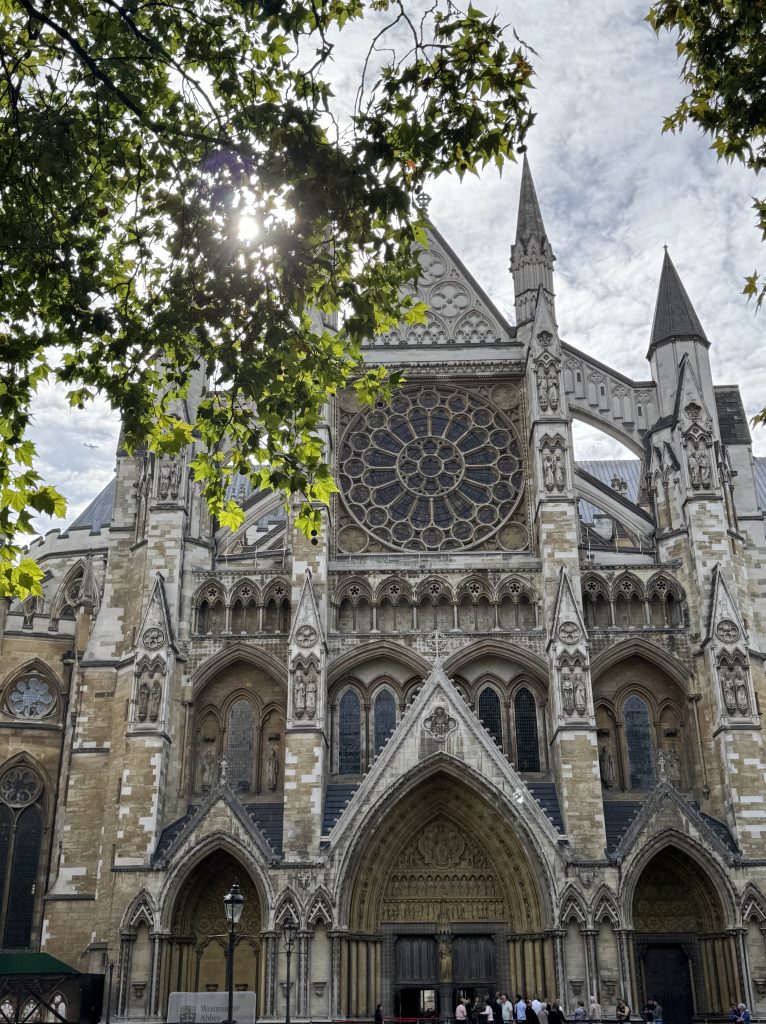
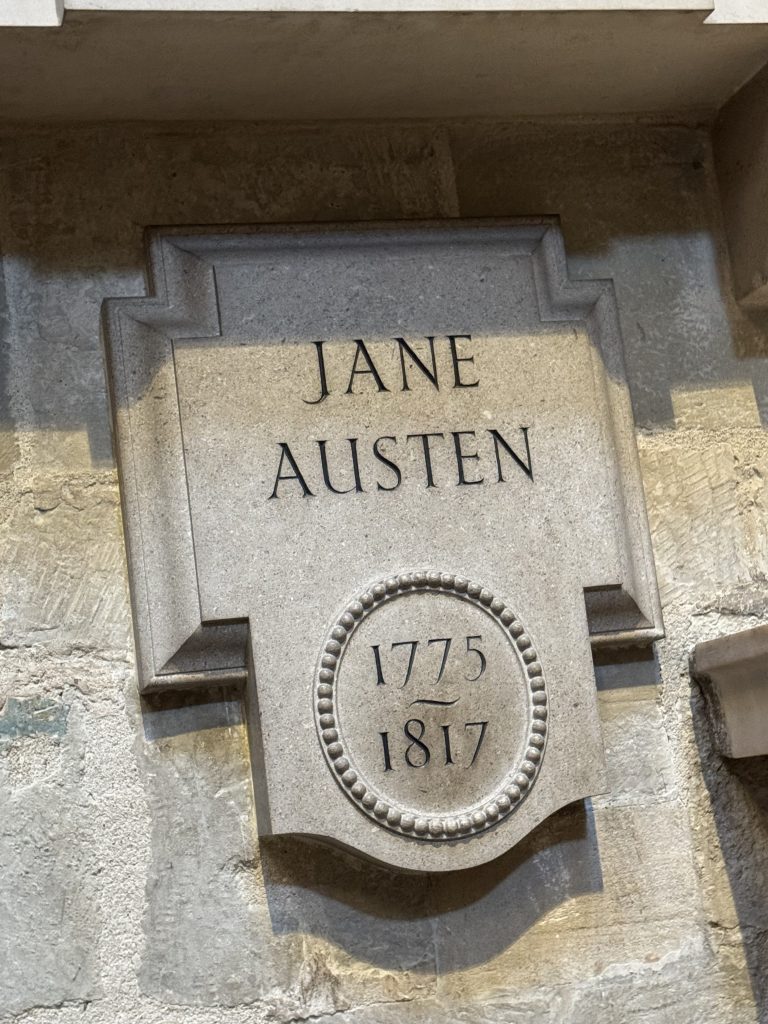
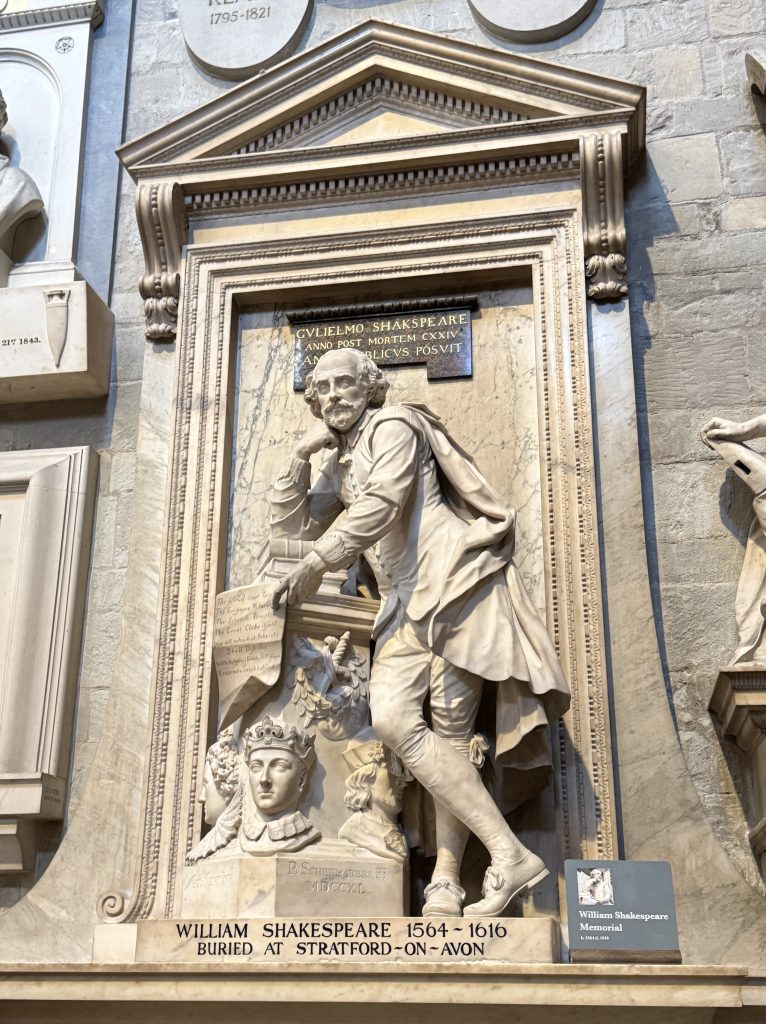
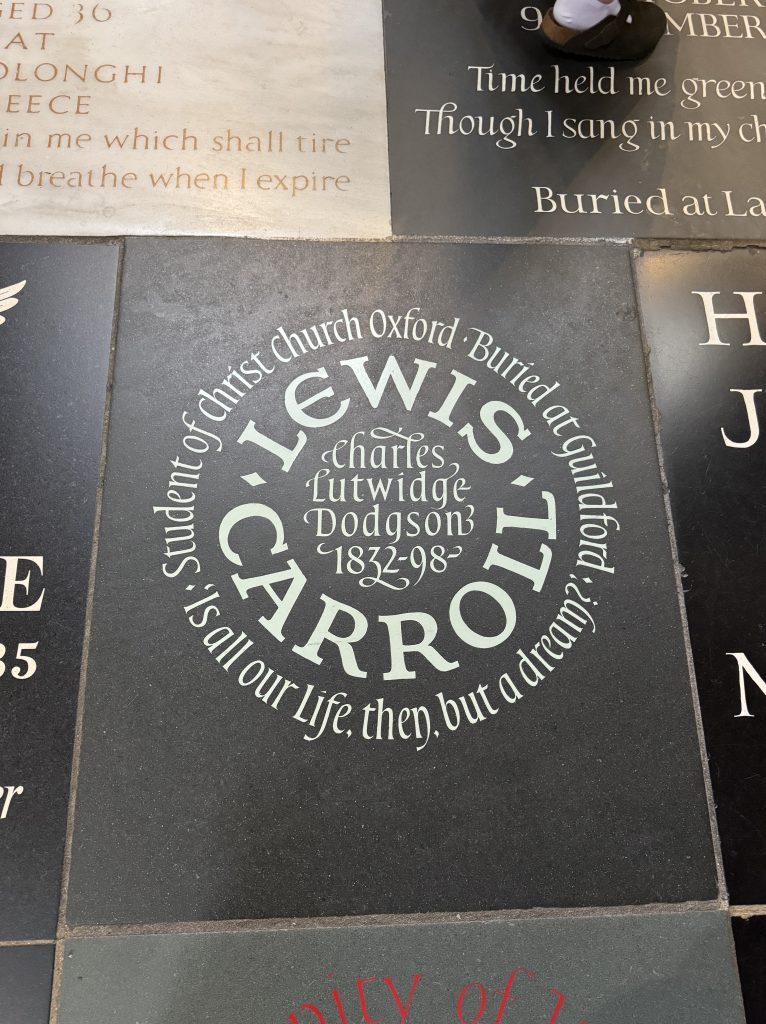
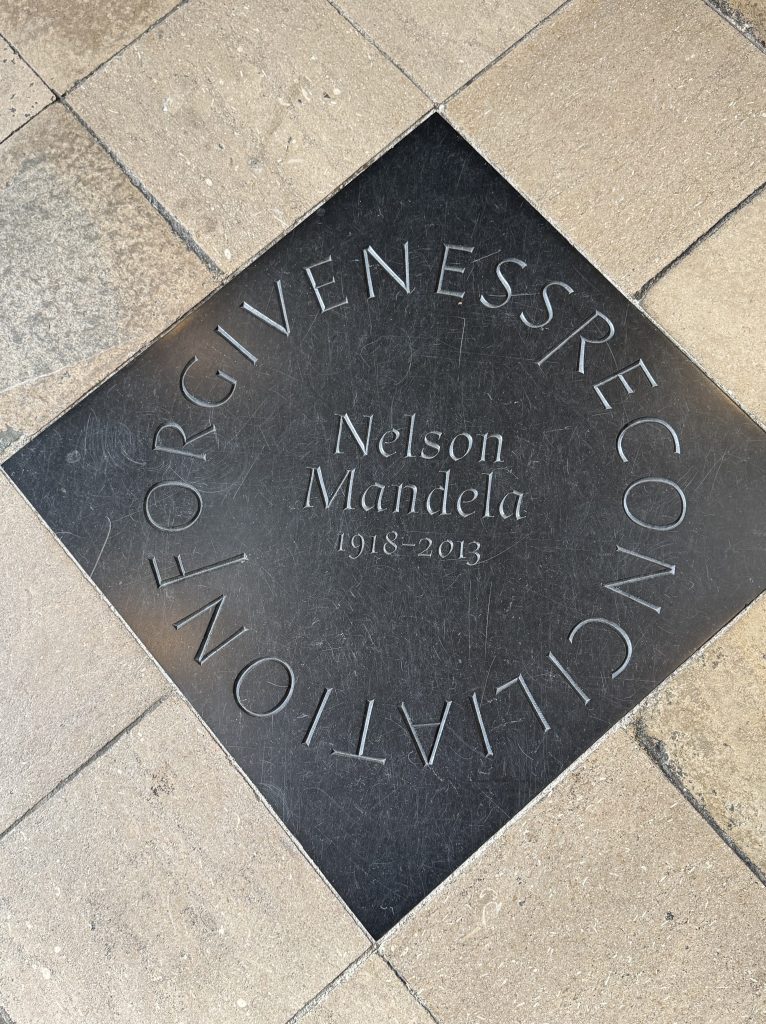
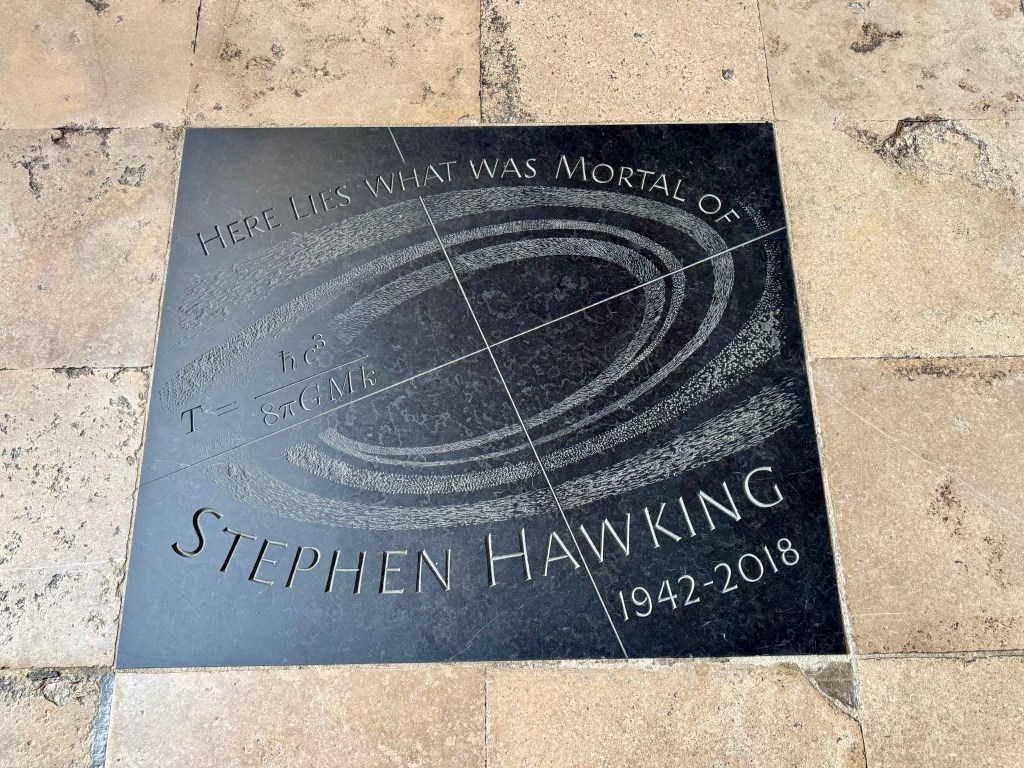
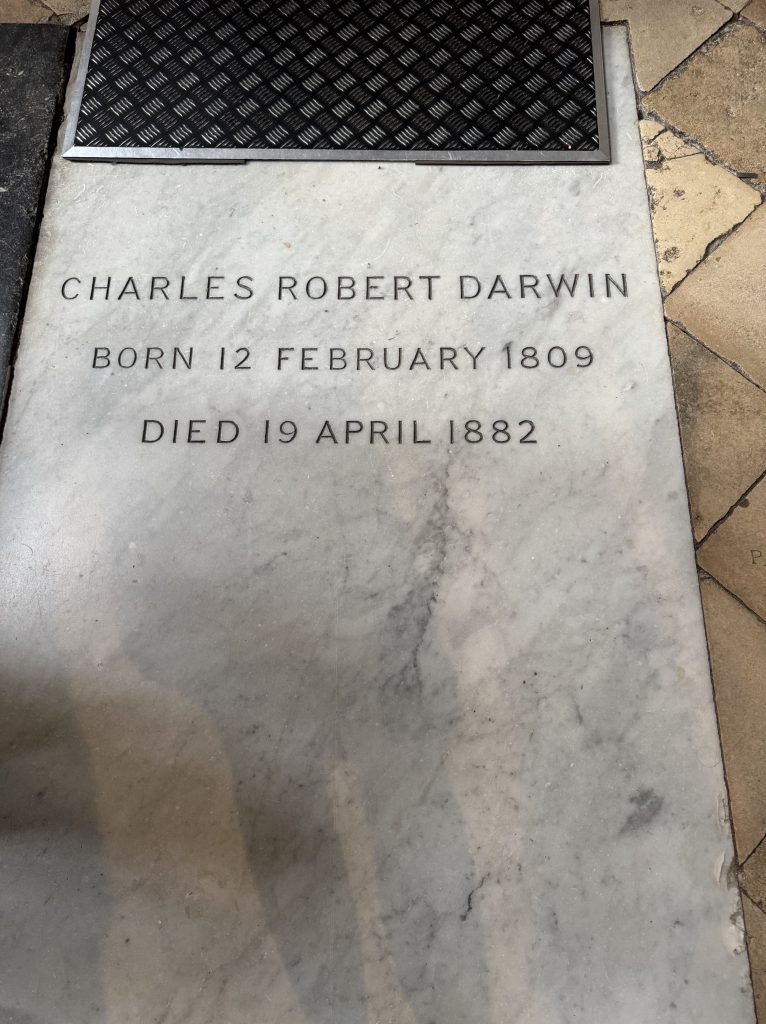
Poet’s Corner and Scientist’s Corner contain memorials and in some cases, the physical remains of some of the UK’s most brilliant minds. I spent quite a bit of time reading stones to find some of the ones that meant something to me.
We did go upstairs to see the Queen’s Diamond Jubilee Galleries, opened in 2018. No photographs were allowed. The most eerie objects were the life-sized funeral effigies made of wood and wax. Effigies were originally carried on top of the coffins during the funeral procession. King Henry VII, Queen Elizabeth I and Lord Nelson were represented.
We have been doing some significant walking since arriving in London. We walk everywhere. We average 20,000 steps per day, though like today, there is also a lot of standing, looking, and reading time in the museums and historic buildings.
Little to no shopping has happened just yet. Starting tomorrow i would like to see if I can change that – just a wee bit.


Leave a comment